Which Restaurant Pages Are The Most Valued by AI
Picture this – you own a diner. You build a website and create restaurant pages on social media. Then you set up a food ordering system, and perhaps a reservation system on top of that. A well-versed Internet surfer that discovers your business will immediately know where to look for the details about your venue and your meals.
But what about AI? Which sources of information does it treat as relevant and reliable? Its findings determine the accuracy of its answers, which matters especially for people who rely on AI instead of browsing the web themselves. That’s why businesses should consider how their information is presented online, and where.
To explore this, we used ChatGPT (running on GPT-5 model at the moment of research) to gather data on specific restaurants, dessert shops, and drinking establishments. We checked what AI says about the business itself, as well as its menuthrough separate prompts. And more importantly - we investigated the most frequent sources. As with service businesses and e-commerce businesses, our research revealed which sites are the most valuable for LLM optimization.
Official restaurant websites - Only the core is consistently included
Unsurprisingly, official websites were the top sources. They usually ranked first in Google when we searched for each restaurant, so it made sense that ChatGPT leaned on them the most. Out of all businesses we analyzed, we found only one that had its website completely omitted on both prompts. The reason? It was a single-page site packed with graphics (including menu photos), maps and virtual tours. However, the text was very limited - just a few quotes and the “Our story" section being less than 90 words long.
Beyond that exception, there were two core pages that AI consistently referred to:
-
Home pages – Referenced for
89%of restaurants. They showed up in both prompt types for47%of businesses, exclusively for general info prompts in41%, and for menu prompts in just1%. -
Menu / Order pages – Used by AI for
87%of restaurants that had them on their website (some businesses had menus as a section, or redirected to an external POS system). These pages were cited for both prompts in34%of cases, exclusively for general info in2%, and exclusively for menu prompts in51%.
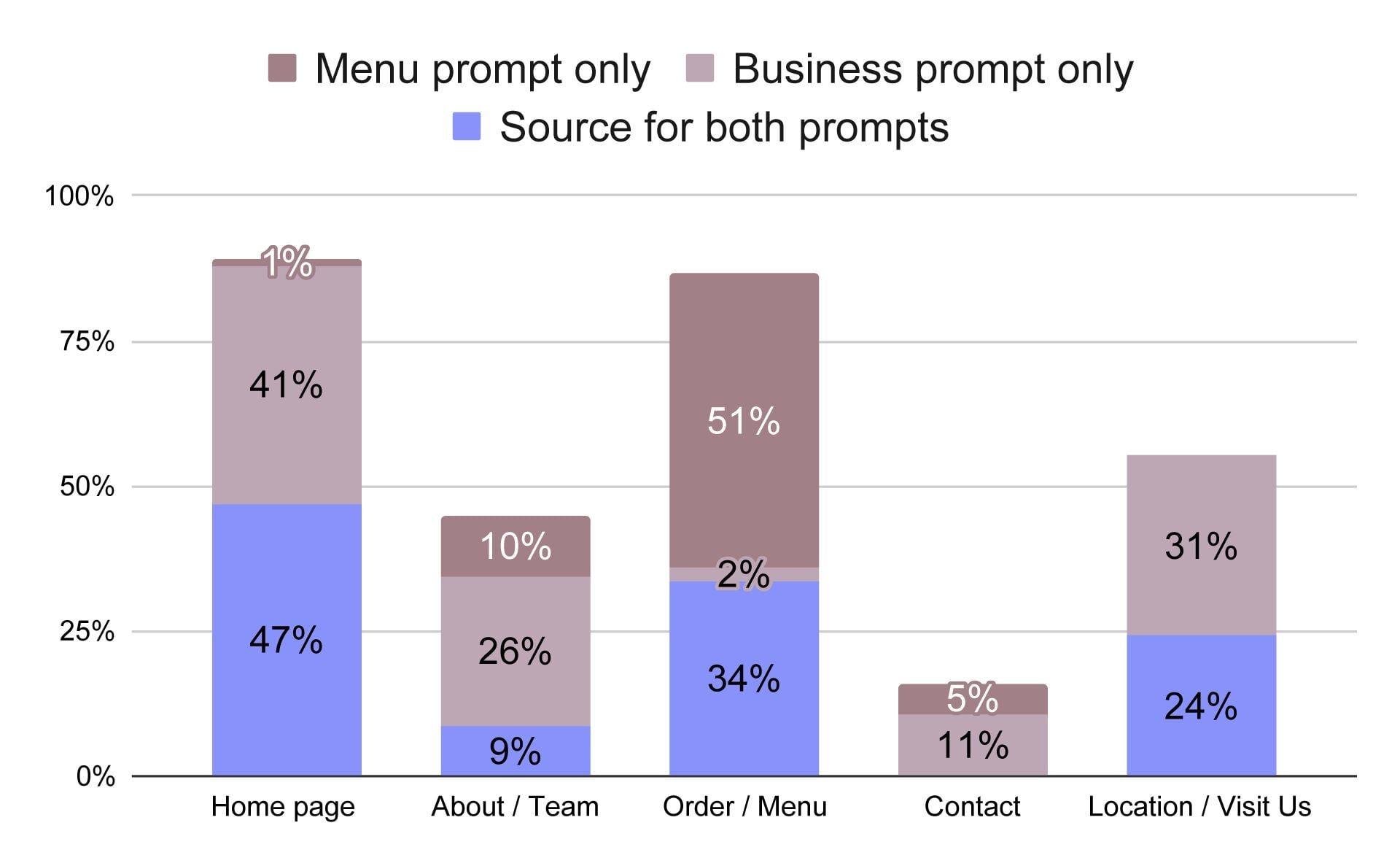
Percentage of subpage types getting used as a source across two tested prompts
Any other subpage types were generally less common. Even About or Contact, which are rather universal, were found in less than 60% of the tested restaurant websites. About subpages were used by AI for queries on just 45% of establishments, and Contact – only 16%.
Review and social platforms didn’t stop appearing
Yelp – Always in Google, almost always in ChatGPT
As we explored the external restaurant pages that AI referred to, Yelp turned out to be the dominant platform by a huge margin. What’s worth noting here is that, without exception, every single tested restaurant had its Yelp page come up in Google.
While ChatGPT didn’t always cite Yelp, we still ended up with that platform being relevant for a whopping 80% of restaurants. That includes 50% where Yelp came up only on general info queries, 7% where it was brought up for menu queries, and 23% where it appeared for both.
Although Yelp does host menus, AI clearly treats it first and foremost as a review hub. The evidence is in frequent highlights of Yelp scores and inclusions of individual opinions, as seen in the screenshot below.
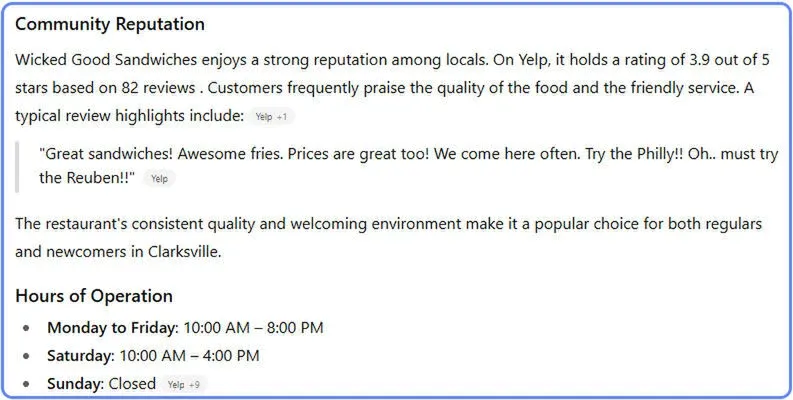
Example of ChatGPT directly quoting Yelp’s reviewer
MapQuest – Very common when we ask for general info
MapQuest scored second among external sources cited by ChatGPT. In 52% of cases it was a source only for general restaurant information, and in 6% it was used to answer menu queries as well – 58% in total.
MapQuest is also a common sight in Google results – it ranked for 87% of the restaurants we checked. Still, in 29% of cases, ChatGPT didn’t consider its restaurant pages relevant enough to use. It’s not too surprising, since the information present on MapQuest isn’t too extensive. It usually sticks to the basics – address, phone number, hours, website links, short descriptions, and user reviews pulled from Yelp and occasionally Tripadvisor.
Interestingly, MapQuest appears to be a particularly popular source for queries on drinking establishments. While AI used its data to answer questions regarding 50% of regular restaurants, that number rises to 88% for bars, pubs and cafés.
Social media has higher omission rates…
What can you expect from the vast majority of restaurants to have? Social media. 98% of researched businesses had a Facebook page, and 86% had an Instagram profile. While those are fantastic for engaging customers and promoting food, AI often overlooks them. In fact, 56% of restaurants had their Facebook page ignored by AI, and 40% had the same thing happening with Instagram.
Once again, it’s difficult to imagine those two platforms showing up more often, because usually there isn’t that much data to work with – shorter descriptions, less reviews, and posts being primarily images or reels.
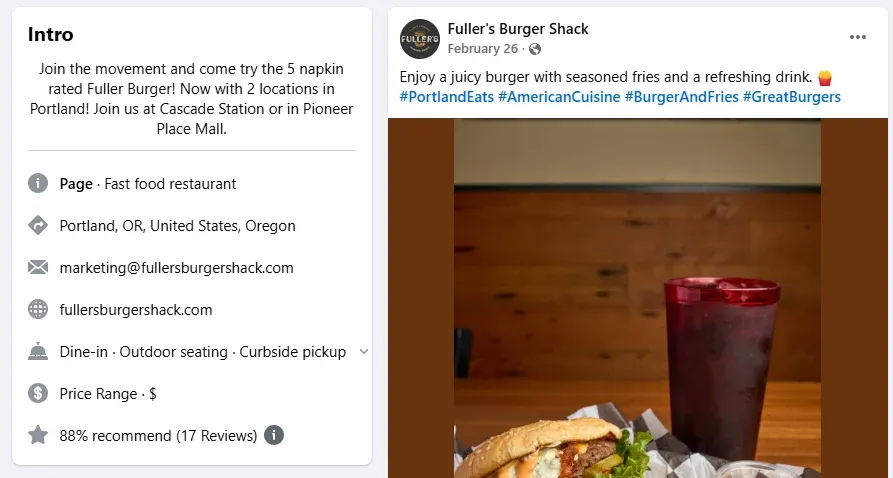
Example of Facebook content, showing limited data for AI to work with
Still, we can observe some differences between regular restaurants and dessert shops or drinking establishments:
- Restaurants –
32%had their Facebook page used by AI;32%score for Instagram - Dessert shops –
60%for Facebook;56%for Instagram - Drinking establishments –
44%for Facebook;64%for Instagram
Combined with MapQuest results, this suggests that AI doesn’t depend as heavily on descriptive data for dessert and drink venues.
…but not as high as Tripadvisor
Tripadvisor is heavily favored by Google, showing up for 90% of businesses we checked. As for ChatGPT? It brought Tripadvisor up for only 27% of them. The omissions often seemed tied to a low number of reviews, with many restaurants not hitting double digits. However, there were exceptions and Tripadvisor was left out for queries on few venues with close to a thousand of reviews.
Varied results between ordering, delivery and reservation systems
Uber Eats & Postmates – identical pages, treated differently
Another key group of sources includes platforms for online orders, delivery and reservations. Uber Eats stood out as both common and reliable, as it was omitted for only 6% of businesses, and cited as a source for 43%. It got used especially often when we asked about dessert shops – it was referenced for 64% of them.
I’d like to mention Postmates here. Though acquired by Uber and featuring identical restaurant pages, AI treated it a bit differently. Postmates was slightly less popular, as it was chosen as a source for 22% of restaurants, with another 5% appearing in Google but not ChatGPT.
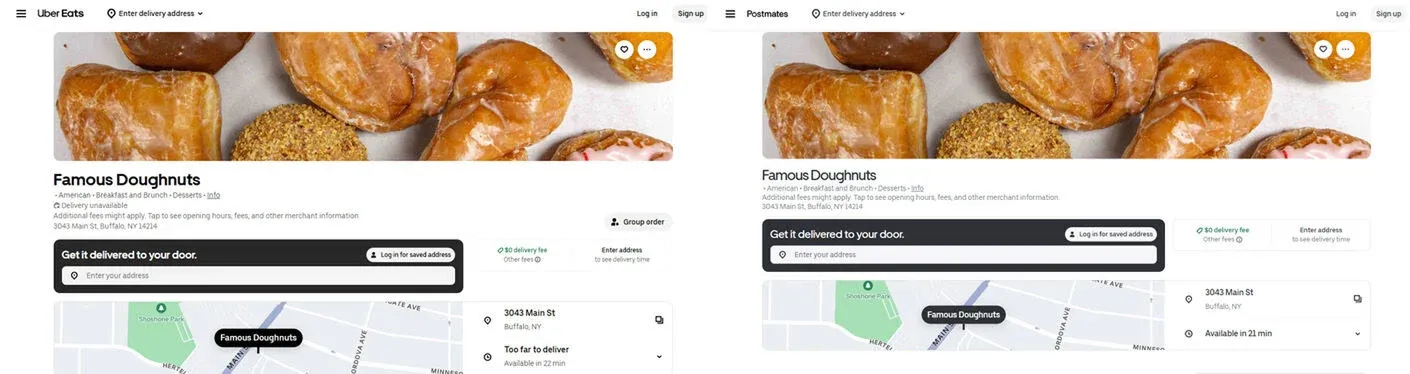
Comparison between Uber Eats and Postmates pages
Even more telling, Postmates was never used by AI to answer general info queries, whereas Uber Eats did – 11% of the time, out of the 37% where it was cited overall.
DoorDash is popular among dessert shops, but order.online sites are MIA
DoorDash served as a source for 31% of restaurants, and got omitted for 10%. Much like Uber Eats, it was a particularly common pick for dessert shops, where it appeared 64% of the time as well.
The same cannot be said for order.online restaurant pages, which are also powered by DoorDash’s Online Ordering System. In Google, these are sometimes ranked higher than the doordash.com equivalents. Despite that, ChatGPT didn’t use order.online sites even once.
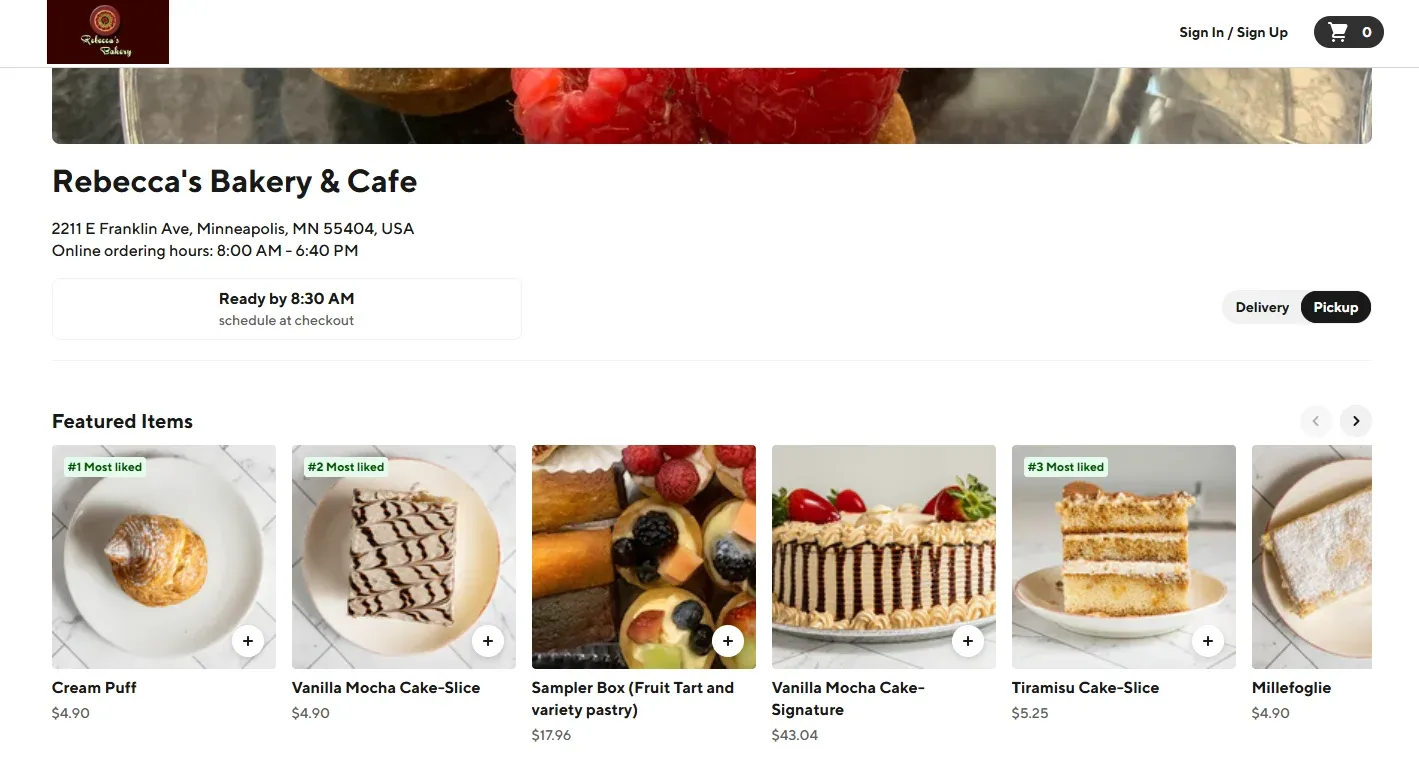
order.online restaurant page - while most of DoorDash’s content is here, user reviews are not present
Unremarkable scores of other platforms
Beyond the major players, other restaurant platforms yielded more modest results:
- Grubhub – system used by
16%of businesses; cited by ChatGPT for11% - Toast – used by
15%; cited for7% - Seamless – used by
19%; cited for5%
For reservation systems, there’s only one that proved somewhat relevant, and that is OpenTable. It showed up in Google results for 21% of researched establishments, and ChatGPT relied on it for 13%. Presence of reviews appears to be the most deciding factor on whether OpenTable makes it to the source list. Without them, it usually does not.
Other sources can get quite diverse
Wikipedia’s inclusion can be a stretch
What I didn’t see too often with service or e-commerce businesses, but was quite prevalent among restaurants, was Wikipedia. ChatGPT included it as a source in queries for 20% of restaurants. But the reasons for its inclusion could get… unusual.
Beyond cases where a Wiki page for the restaurant itself was found, AI sometimes pulled from pages about:
- The building housing the restaurant
- TV show featuring the restaurant
- A type of meal served there
- A different restaurant owned by the same person
- Similarly named diners (e.g. “Willie Mae’s Scotch House" came up when searching for “Willie’s Chicken Shack")
- Most outlandishly, AI linked Bar Uno to the first episode of Better Call Saul, also titled “Uno"
Digital news and food writer articles are often referenced
AI places high value on strong signs of a restaurant’s recognition. This can come from a news article dedicated to the business, or a mention by a food writer highlighting it as a must-visit spot in town, or one of the country's best places serving specific meals. Whatever the case may be, AI puts a lot of trust in such articles – it uses them to assess and present how well-established a restaurant is.
In our research, ChatGPT sourced a news magazine, blog or journal for 58% of the restaurants we asked about. There are two more common sites from this category – Eater (9%) and Axios (10%), where the latter never appeared in Google’s first two pages.
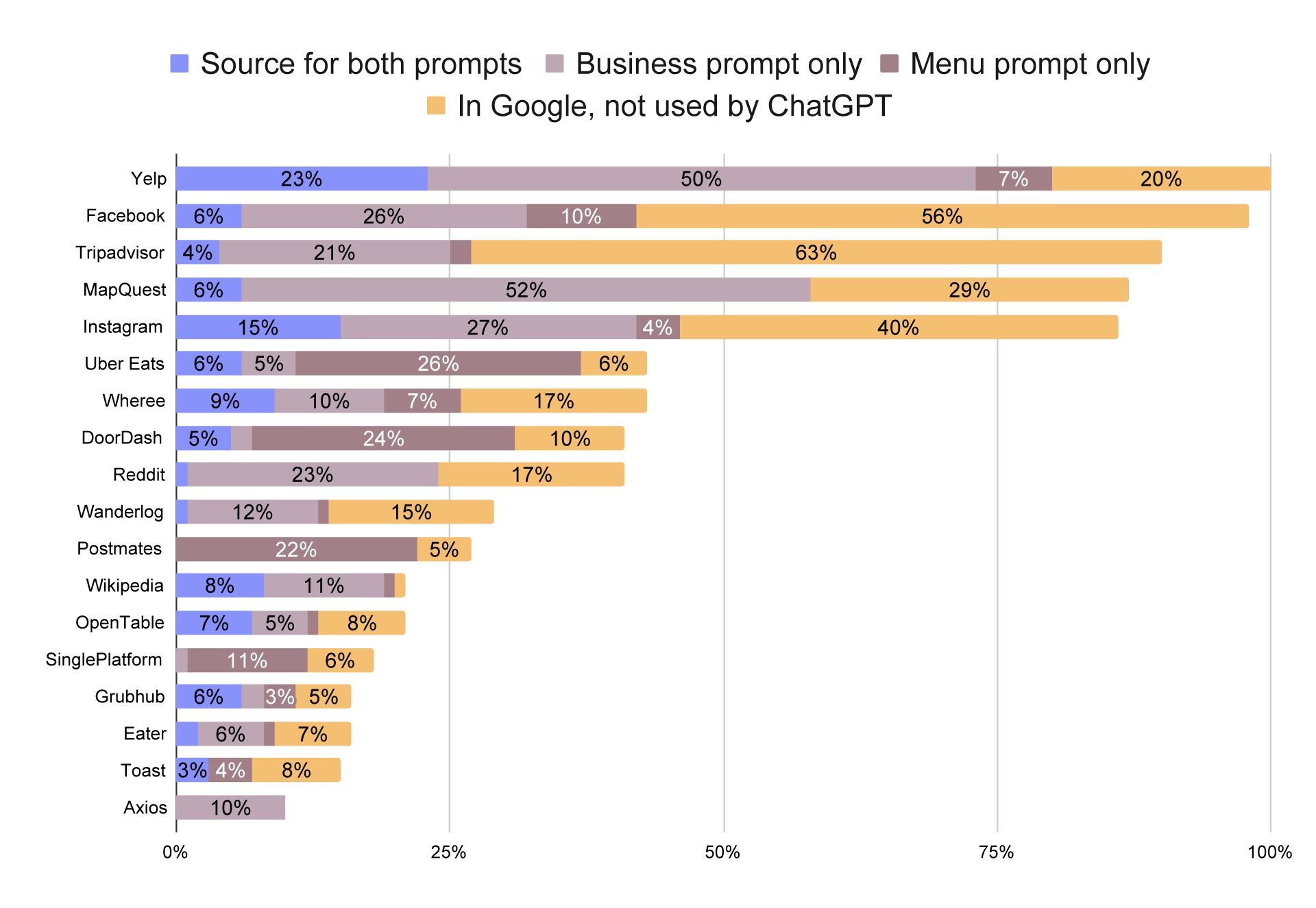
Most common external sources - usage by ChatGPT across two tested prompts, and appearances in Google's top 20 results without being ChatGPT's point of reference
Niche platforms don’t contribute much
Platforms catering to specific targets are easily overshadowed. As seen with those three examples:
-
HappyCow, which lists vegan-friendly restaurants. It appeared for only
5%of businesses in ChatGPT, androughly double that in Google. This was the highest-scoring niche platform. -
BringFido, which focuses on pet-friendly places. We found that
8%of restaurants have a page there, but AI used it for just2%. -
Find Me Gluten Free, which despite showing up more frequently in Google than the previous two (
11%) never got cited by AI.
The reason is clear – restaurant pages on these platforms provide minimal general information. Instead, their content emphasizes niche needs (by e.g. listing only vegan or gluten-free menu items) rather than broad restaurant data. Even the user reviews, which AI usually refers to, don’t help these platforms’ visibility. That’s because user opinions also focus on addressing those niche needs, which AI deems less relevant.
Beware of unofficial restaurant websites!
Before we delve into those, I need to present one more observation from the research. When ChatGPT was asked about menus, up to three external domains appeared in its sources 60% of the time. Beyond the restaurant’s own site, AI would usually pull info from POS systems with clearly listed menus and stop its search there.
Because of this I got concerned once I saw how many unofficial restaurant websites were detected by AI. I found that for 26% of the checked venues such websites were included in the source list. They would most often use res-menu.com, menu-world.com, or restaurants-world.com domain, and state that they’re community-maintained.
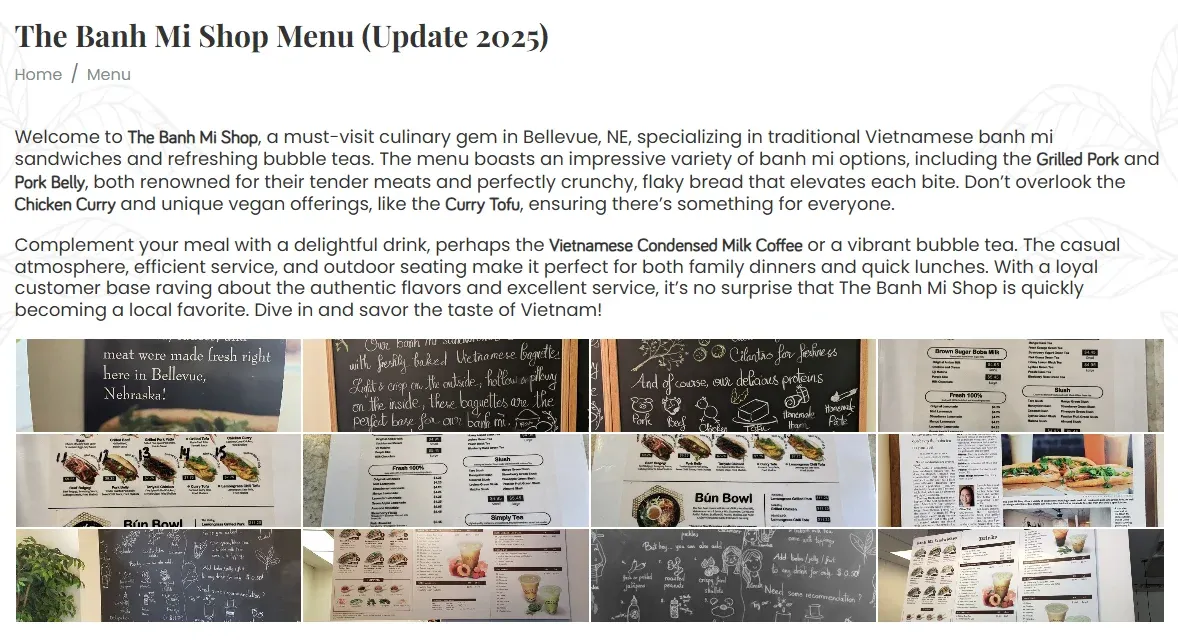
Example of menu page’s copy and gallery from an unofficial site
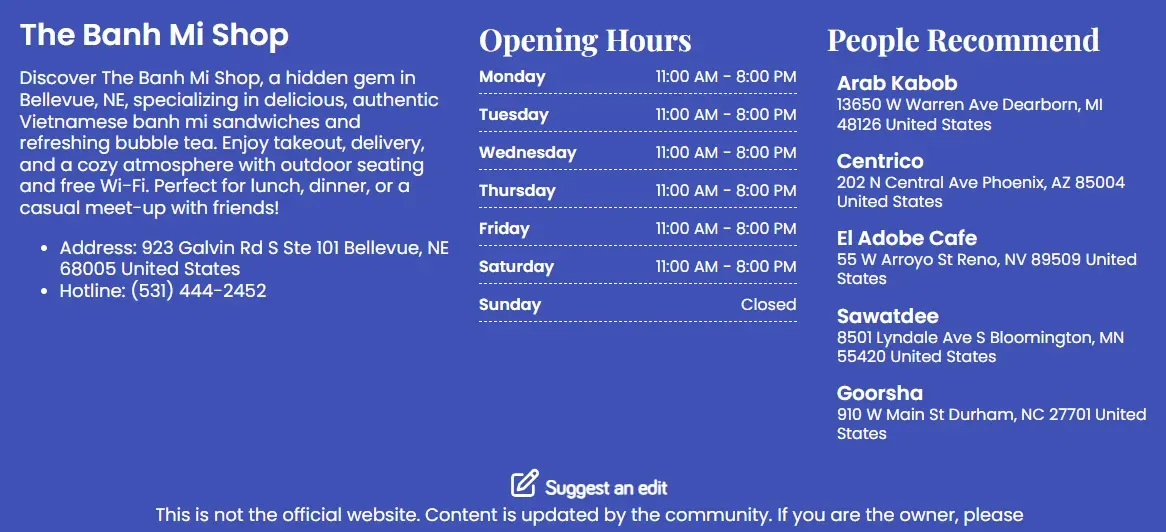
Footer from an unofficial site - note AI-generated copy and other venue recommendations
Why are these a problem? Simple – accuracy issues. Copy in those sites is AI generated, doesn’t align with the restaurant’s brand, and tends to describe features or tell stories that aren’t true. While addresses and phone numbers are usually correct, the opening hours and especially menus often aren’t. The combination of having those sites picked in place of more credible sources (sometimes even the official restaurant sites!) and the limited number of cited sites is bound to bring undesirable results.
Final takeaway
While AI clearly favors some restaurant pages over others, it can get quite creative in picking valuable sources to extract info from. It does a good job of finding and prioritizing the official business websites, but it’s not foolproof. Unofficial websites can occasionally sneak in, but as long as you don’t overrely on graphical content, especially on home and menu pages, your site should be seen as valuable. And with tools like our AI website generator you can craft an optimized one from scratch in minutes.
If you want to get people to learn accurate info about your venue through AI, you still need to let more sites talk about it first:
-
Without question Yelp should be your top focus, as ChatGPT very frequently cites its user reviews.
-
MapQuest also contributes often, while platforms like Tripadvisor, Wanderlog or Wheree aren’t nearly as popular.
-
If a food blog owner or journalist ever offers to write about your business, say yes! These articles signal credibility to AI.
As for having AI tell users about your restaurant’s menu, POS systems help with maintaining information accuracy the most. Uber Eats, DoorDash and Postmates are the three sources that AI is most likely to draw from.
While LLMs do not hesitate with diversifying their sources, the aforementioned positions are key to keeping information from AI detailed and consistent. Aligning your official site, external pages, and AI responses strengthens your restaurant’s legitimacy.
Legitimacy builds trust. Trust drives engagement. Engagement fuels discovery. Discovery strengthens legitimacy. This is how AI creates a cycle that keeps restaurants going online.
The data and statistics presented in this blog post come from a research study conducted by IKOL in 2025. To learn more about IKOL research methodology and explore other findings, visit: ikol.com/research.