Service Business Queries: Where Does AI Look For Info?

Here’s a quick experiment – try asking ChatGPT about your business and see what it says. What’s in there is roughly what people interested in your services will also see after asking the same. Whether you find the returned answer impressively accurate or full of nonsense, one thing’s for sure – all that information must have come from somewhere.
If your business has a website, that’s a natural starting point. But what if it consists of multiple pages? Are all of them equally as important for ChatGPT? Not only that, there are other platforms and websites to consider. Your social media profiles or business listings for instance. How much do any of them matter for GEO?
We conducted research around service business websites and what AI has to say about them. And as we did, we may have found several answers to this one question concerning LLM optimization – just where does AI search for all that data?
Which subpages matter most to AI?
Before we say which subpages AI usually relies on, we need to outline the four most common types across all websites:
- Home page – by definition a website cannot exist without it.
- About Us / Team page – found on
72%of sites, usually introducing the company, its staff, mission and history to the visitor. - Service page(s) – present on
76%of websites, either as a full list or split across individual service pages. - Contact page – found on
74%of the websites we reviewed.
Now, let’s look at how often each of these pages was actually referenced by ChatGPT when describing a service business.

Percentage of subpage types getting used as a source
Home page – The entrance is right this way
In most cases this is where a web surfer would expect the most content to be. That’s because businesses typically want to immediately leave a strong first impression with a clear snapshot of their work. As a result, in 87% of instances ChatGPT used a business’s own home page as a source. Interestingly, among the remaining 13% of companies, approximately half of those still had at least one other page from their site referenced.
About Us – You want details? Here's the details!
Although the websites include it nearly as frequently as the remaining two common subpage types, About Us was noticeably more often used as a source – 74% times. Why? Because it often includes details about the business owner and the key team members. These included their name, roles, specialties, experience and education when applicable. Such details helped AI paint a richer picture of the company.
Services – As long as it’s more than just a list
AI took notice of Service subpages in 54% of its company descriptions. It appears that while AI’s responses tend to list provided services one after another, it doesn’t find such stark bulleted lists of offerings valuable. Pages that gave more context, such as what the services exactly involved, had a better chance of getting used.
Contact – AI can find that elsewhere
Although ChatGPT was very likely to mention any sort of contact data, only 47% times it came from a Contact subpage. There are two combined factors that resulted in a lowered percentage here. Firstly – many such pages only include a basic contact form, which means not enough data for efficient LLM optimization. And secondly – contact details are often pulled from other sources like business directories or social platforms, which we will get into later.
Less common subpages – Do they even matter?
Any of the not so widespread or fundamental pages were rarely considered by AI. Nevertheless, there are three that still could make an impact when they existed:
- Testimonials / Reviews – It was difficult to not come by a response that wouldn’t dedicate one paragraph to the business’s ratings and reputation. However, rather than checking for website testimonials, ChatGPT preferred
Google Reviews or other review platforms. - Blogs – These can help highlight a business’s expertise and also somewhat serve as an archive, where owners sometimes reminisce on past events their company participated in. Although
About Us fulfils both of those functions better, as blogs require extra steps to navigate through. - FAQ – The ones we saw used as sources
didn’t cover just basics only(location, service list, hours, pricing etc.). They were rather comprehensive – from 9 to 19 questions. The only instance that went below those numbers included content that would typically belong in the About Us subpage, as it briefly described the company’s story.
External sources – Influences varied by industry
When you look a business up on Google, the link to its website will be without a doubt the first one to show up. But just like a customer might look beyond your website for proof that you’re legitimate, so does AI. It doesn’t just find the business’s own website and call it a day. It will check for external sources too. And as it turns out, those vary quite a bit depending on the service business type:
Home & field service
When asked about these, ChatGPT was shown to rely a lot on one particular source – Reddit. In fact, it showed up as a source for a whopping 84% of businesses from this category. The weird part though is that the discovered Reddit posts often do not mention the specific business we asked about. As long as they come from subreddits either related to its industry or location, AI sees them as potentially useful. Other sources that happened to be more common here than across other industries are BBB (Better Business Bureau), Chamber of Commerce, Zaubee and Best Pros in Town.

Wellness & personal care
ChatGPT is much more likely to look for Facebook and Instagram pages when asked about a service business from this category. Both of those social media platforms contributed to 52% of its answers. There is one thing to note though – every single wellness company we picked for the research had its own Instagram page, and only two didn’t have a Facebook one. Reddit and Yelp also had a notable presence (44% and 56%, respectively).

Health & medical
The most common source brought up in this category is MapQuest. It was listed as one in responses to 52% of the businesses we asked about, although we were able to find 16% more of our researched businesses through it. Other sources were more scattered. We saw news articles on official TV sites where the researched company was involved, as well as multiple platforms dedicated to medical businesses as a whole, specific industries, or location-based ones. The one we encountered the most was Healthgrades, but even that was used as a source in just 24% responses.
One interesting thing to observe - since quite a few service business owners brand their operations under their own name, ChatGPT’s sources tended to focus on those individuals rather than their entire businesses. Those could range from doctor profiles to interviews, or even Wikipedia pages.

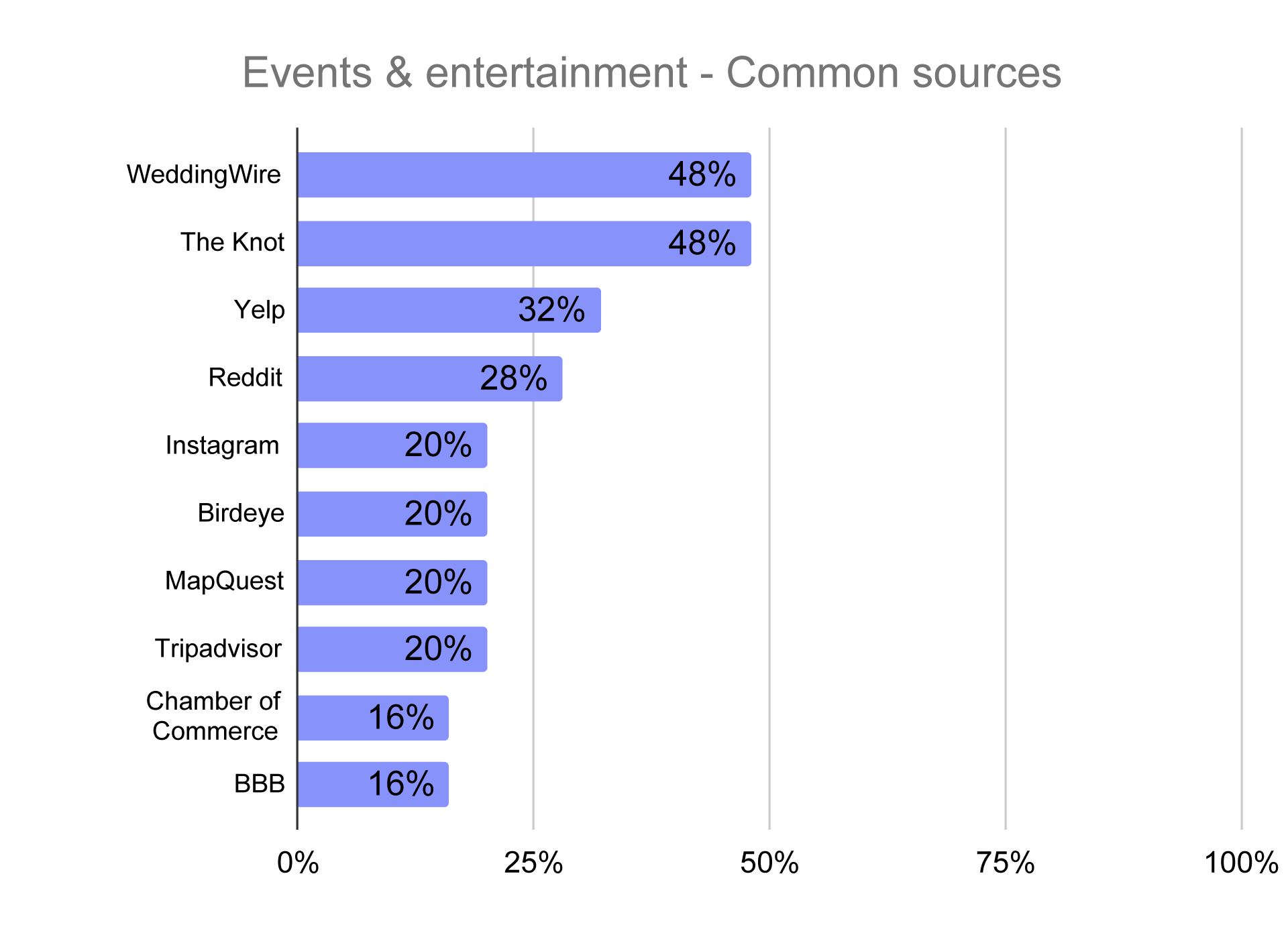
Events & entertainment
By far the biggest focus on niche oriented platforms was seen here. Especially if we look through wedding service providers alone – in 67% of queries about these (and 48% in this category overall) we’ve noted WeddingWire being one of the sources. Similarly, The Knot has also shown up in 48% of all AI replies. And it wouldn’t stop there, as six other platforms for wedding businesses across the entire US were found in the meantime. On the other hand, when we moved from anything wedding related and checked out tour guides, we saw ChatGPT referring to Tripadvisor every time (otherwise it only showed up in responses to questions about two spa businesses).
What Google sees that ChatGPT doesn’t?
You might assume that if a site ranks highly on Google, it’s guaranteed to be a source for ChatGPT. But that isn’t always true! Usually, ChatGPT extracts data from up to 20 different URLs, which can include multiple subpages from the same domain. On the flip side, Google generally attempts to diversify the domains appearing in search results. This means that there’s a high chance for a site that’s present within the first two pages of Google results to not be picked as a source by AI.

External sources - usage by ChatGPT and appearances in Google's top 20 results without being ChatGPT's point of reference
So, which sites were most consistently brought up by both ChatGPT and Google, suggesting the most effective combination of SEO and GEO? There are two clear winners here – Birdeye and Chamber of Commerce, which were relevant in over 30% of all responses. At the same time, with both of them we only saw singular instances of a business with its page showing up on Google’s top 20 results, but not on ChatGPT.
BBB and Reddit also performed well across both engines, where the latter was in fact more favored by ChatGPT. Other honorable mentions belong to Zaubee, Best Pros in Town and Loc8NearMe, although they were overall not as common as the platforms we’ve named here up until this point (each of them was a source for16% of answers or less).
Yelp was met with mixed treatment. It was deemed relevant in 39% of all AI responses, but it appeared in Google results for 45% more businesses. MapQuest found itself in a similar situation – 45% times it was a source for AI, but also in 31% cases it showed up only in Google.
And then there are several platforms clearly favored by Google:
- Facebook - used as a source for
24%of AI replies; brought up only in Google for58%of researched businesses - Instagram - source for
18%of AI replies; in Google only for37%of businesses - Nextdoor - source for
12%of AI replies; in Google only for28%of businesses - LinkedIn - source for only
7%of AI replies; it appeared in Google results7 times as often
The first three probably do not show in ChatGPT’s list of sources often due to lack of crawlable text content that would be accessible without login requirement. LinkedIn pages on the other hand usually focus more on employees and their personal career history, rather than the business itself.
Final takeaway
Many service business owners now face a whole new challenge. On top of SEO, they now have GEO to look out for too, which introduces new challenges explained in our post about LLM optimization. Luckily, the methods to overcome those become clearer as the time moves on.
If you want ChatGPT (and, by extension, your potential customers) to get an accurate view of your business, pay special attention to your Home and About pages. Make extra sure that those are filled with content that’s both clear and descriptive.
At the same time, do not underestimate the value of external sources and keeping things consistent between those, and your main website. Prioritize your presence on platforms like Chamber of Commerce, Birdeye and BBB, as those are well optimized for both search engines and generative engines. Reddit is also very much worth looking into when prioritizing GEO.
By aligning your website and external profiles with what AI manages to find, you’re setting your service business up for more recognition and more accurate presentation. LLMs rapidly become a bigger part of how people search. That’s why staying proactive in this field could give you a real edge over the competition.
The data and statistics presented in this blog post come from a research study conducted by IKOL in 2025. To learn more about IKOL research methodology and explore other findings, visit: ikol.com/research.