Why a Scheduler Might Be the Most Important Tool You’re Not Using

They came to your site. They were ready to book. But then… no scheduler. Just a phone number. A contact form. Maybe a vague promise to “get back soon." So they left.
Meanwhile, your competitor—who already jumped on one of the top scheduling apps without you noticing—is packed solid for the entire next week.
This post isn’t just about why service scheduling software matters. It’s about how absurdly few businesses actually use them, what they’re missing out on, and how you can win by doing the simplest thing: letting people book you.
Who actually needs a scheduler?
When it comes to offering services, one thing has always been true: the customer calls the shots. And if you want to sell your services efficiently, a scheduler isn’t just a nice-to-have — it’s essential.
Let’s look at what customers actually prefer:
As many as 60% of people say they usually book services online, while 33% prefer to do it over the phone. The remaining 7% choose other methods.
And when customers are given multiple booking options, 67% opt for the online route.
So yes — most people want to book online.
Traditional methods like phone calls still have their place, especially for certain demographics or edge cases. But the future? It’s digital. And the share of customers expecting instant online booking will only grow.
What about the business impact? The numbers speak for themselves:
Local businesses increased their revenue by 120% after adding online booking systems to their website.
So yes — online booking pays off. If you're still managing appointments only through calls, emails, and sticky notes, you're missing out on what modern job scheduling software can do — for you and your clients.
But not all service scheduling software is created equal.
What should a good booking system actually do?
On the surface, booking seems simple: a customer picks a time slot, hits “book," and just like that, the appointment is set. The service provider sees it pop up on their calendar, and everyone’s happy. And for many industries, that’s enough.
But others need more. The way certain businesses operate can make or break the kind of booking tool they need — and a one-size-fits-all solution doesn’t always cut it. Not sure if job scheduling software is right for your business? Let’s take a look at who’s using it — and what kind of customization they need.
🚘 Booking for field services
For industries that rely on coordination and timing — like repair crews or cleaning services — job scheduling software isn’t just helpful, it’s essential. These companies need systems that support real-time address input, route planning, and client notes (like where to park or access the building). They often assign jobs to specific team members, manage travel time, and connect the whole flow with invoicing and job tracking. Without these features, scheduling becomes guesswork.
🪷 Beauty & wellness appointment scheduling
Salons, massage studios, nail bars, and even pet grooming businesses thrive on personalization. Clients often want to choose who provides the service, and businesses need a way to manage each staff member’s availability. For beauty and wellness, top scheduling apps often include staff selection, recurring appointments, and service customization options. — which keeps both clients and employees happy.
🏃 Fitness booking features
Gyms and group classes like yoga have a different rhythm. Classes need attendance tracking, pass validation, and timely reminders. People want to confirm their spots, manage recurring sessions, or get nudged when it’s time to show up. A solid booking system keeps the pace without extra admin overhead.
🩺 Medical & therapeutic service booking
For doctors, dentists, and physical therapists, the bar is higher. In healthcare, service scheduling software tools need to be compliant with health regulations like HIPAA, support secure communication, and sometimes verify insurance. It’s not just about making things easier — it’s about making them safe, accurate, and professional.
🍽️ Restaurant reservation systems
Finally, restaurants bring a mix of client-facing and staff-facing complexity. High-end restaurants often use full-blown restaurant management systems that combine online booking with floor planning, table rotation, and staff logistics. These systems are powerful, but also pricey. Smaller spots — like cafés or bistros — might not need all that. Still, giving customers an easy way to reserve a table online can reduce phone time, eliminate no-shows, and improve customer flow. In 2023 alone, 54% of restaurant bookings in the U.S. were made online — a number that’s only going up with Millennials and Gen Z leading the digital charge.
Top scheduling apps for different sectors often include features like these—maybe your business could benefit from some of them?
So how many websites actually use booking systems?
To find out, we analyzed over 3,600 business websites. Our sample included service providers, online stores, restaurants, and personal websites. What we found was surprising: only 5.13% of all websites we looked at had any kind of online booking system. Here’s how it breaks down by category:
3.14%of service business websites offered online booking2.54%of online stores had a booking feature16.54%of restaurant websites had booking systems- And
2.54%of personal websites featured some kind of scheduling software
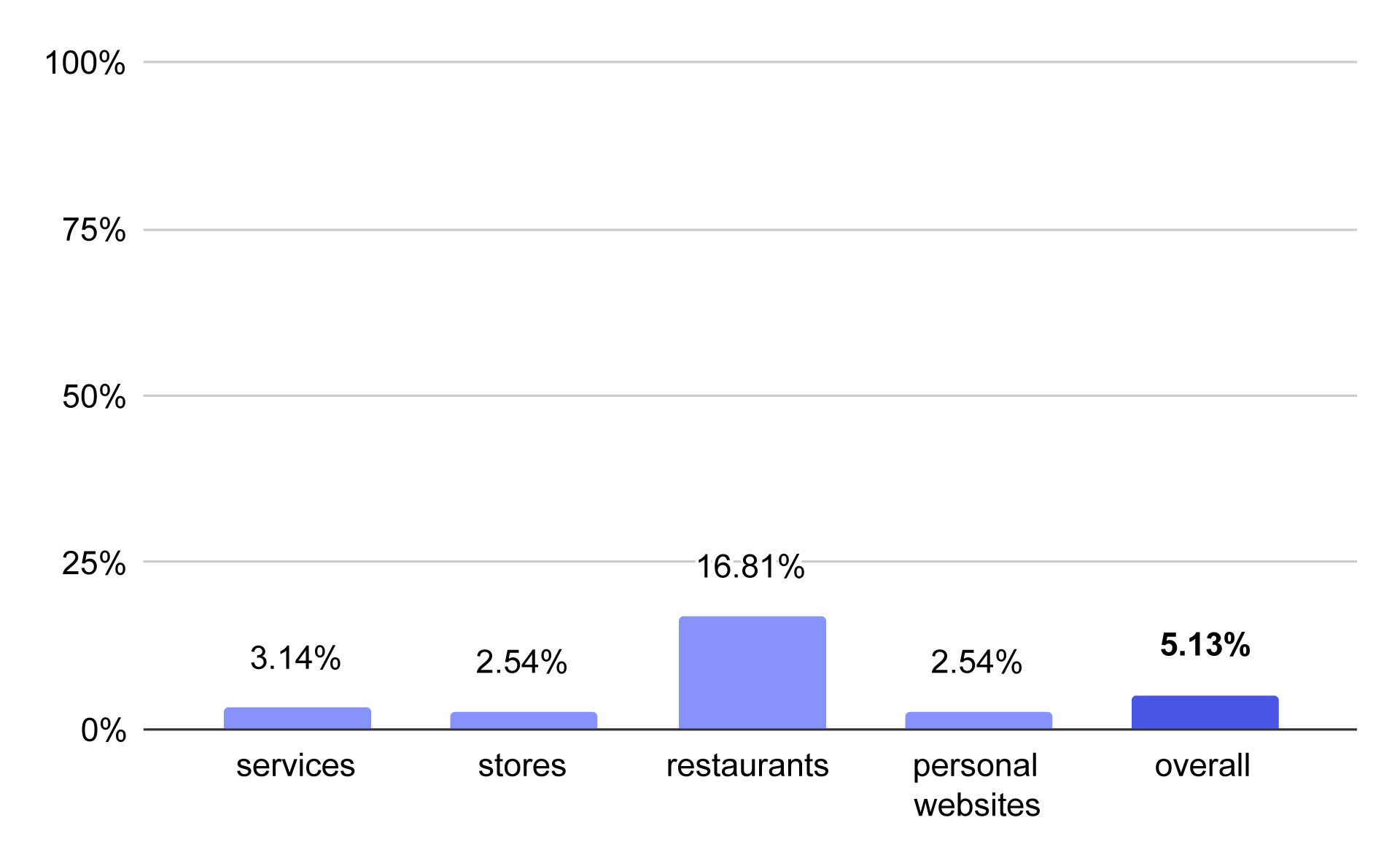
Percentage of business websites with booking systems
So what can we make of these numbers?
Let’s start with stores and personal websites. In the case of personal sites, the presence of a booking system often points to freelance or consulting work — these sites tend to double as portfolios and allow visitors to book sessions, consultations, or collaborations directly. As for stores, many brick-and-mortar locations offer services in addition to products — things like rentals, servicing, or repairs — and that’s likely where online booking comes into play.
But now let’s look at actual service-based businesses. That 3.14%? Incredibly low. After all, most service businesses revolve around scheduled appointments. Sure, there are exceptions — like a local print shop or a key duplication booth — and of course emergency services like roadside assistance might not rely on advance bookings. But those are outliers. For the vast majority of service businesses, scheduling is part of the model. Which means most of them are still relying on phone calls, email threads, or contact forms — ignoring the speed, clarity, and user preference that come with a modern scheduling system.
Now, which service industries are actually leading the way? In our data, 40.54% of yoga studio websites featured a built-in scheduler — the highest of any category. Close behind were spas (30%), beauty salons (22.22%), tailors (20%), and tutors (20%).
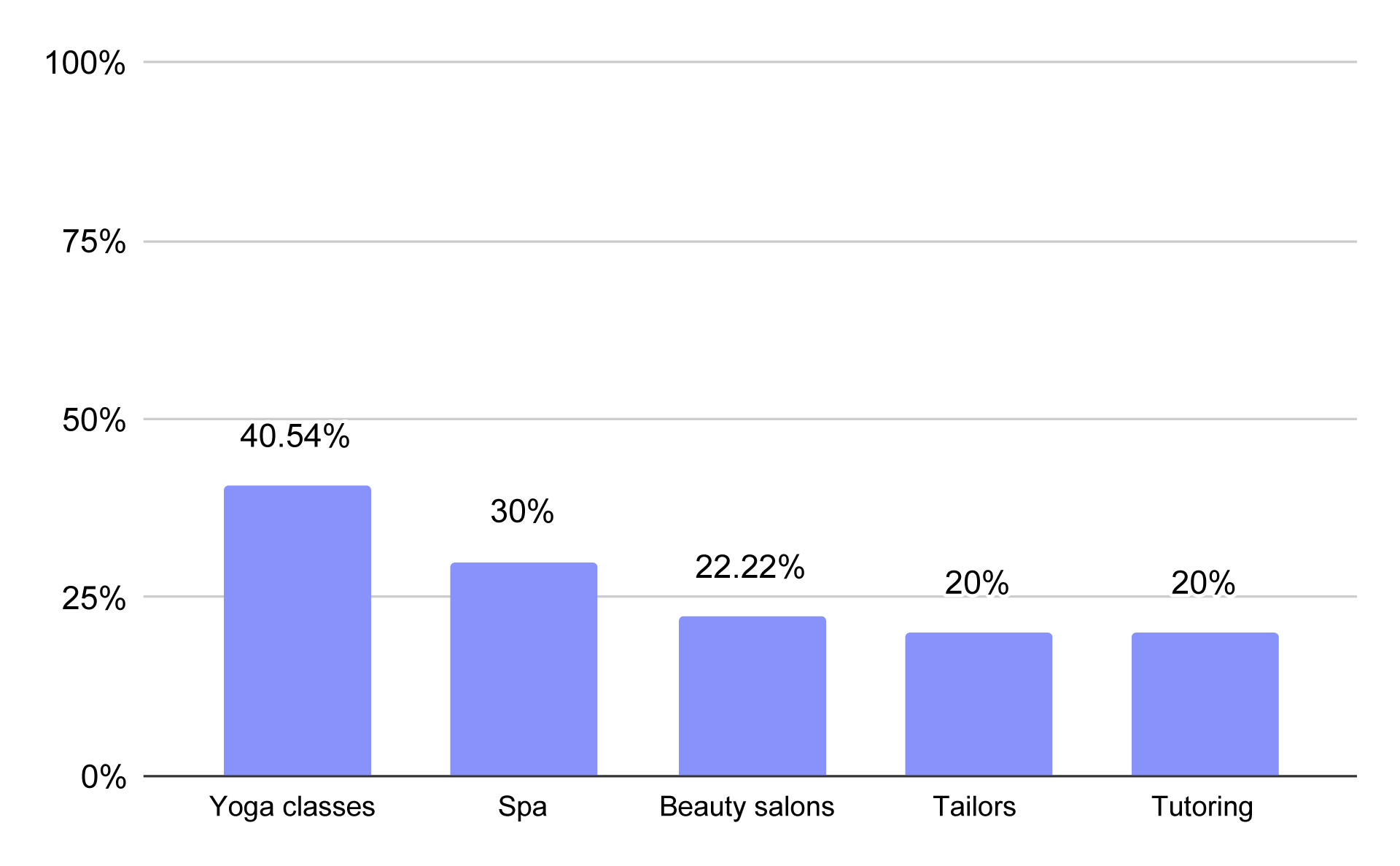
Top service sectors with online booking on their sites
Restaurants, overall, showed the highest rate of booking system adoption — 16.81% on average. But the data varied significantly within the category. Among upscale restaurants — particularly those offering French or Japanese cuisine — booking systems were present on up to 80% of websites. Meanwhile, none of the cafés or bakeries in our sample had an online booking system.
That doesn’t mean they weren’t taking reservations — they were. But it happened through traditional channels like phone or email. Practically every reservation system we found on restaurant websites was part of a comprehensive restaurant management system (RMS) that included both client-facing and internal tools, like digital floor plans or table management. These systems are powerful, but also expensive — often out of reach for small or just-starting-out venues.
Still, that’s not really an excuse. If you run a local café, you may not need a real-time floor manager, but offering customers the option to reserve a table online? That’s a no-brainer. Especially when it saves you the constant back-and-forth of phone calls, DMs, and email chains.
Online booking isn’t just for the big players anymore. It’s becoming the baseline.
What’s the best way to add a scheduler to your website?
We know by now that many businesses are missing out on the benefits of online booking. But what about those who are using service scheduling software — how are they actually implementing them?
According to our data, 52.9% of booking systems were external links that redirected users off-site. Next 46.1% were embedded widgets directly on the website. And the remaining 1% were native systems — custom-built solutions, likely developed specifically for that site.
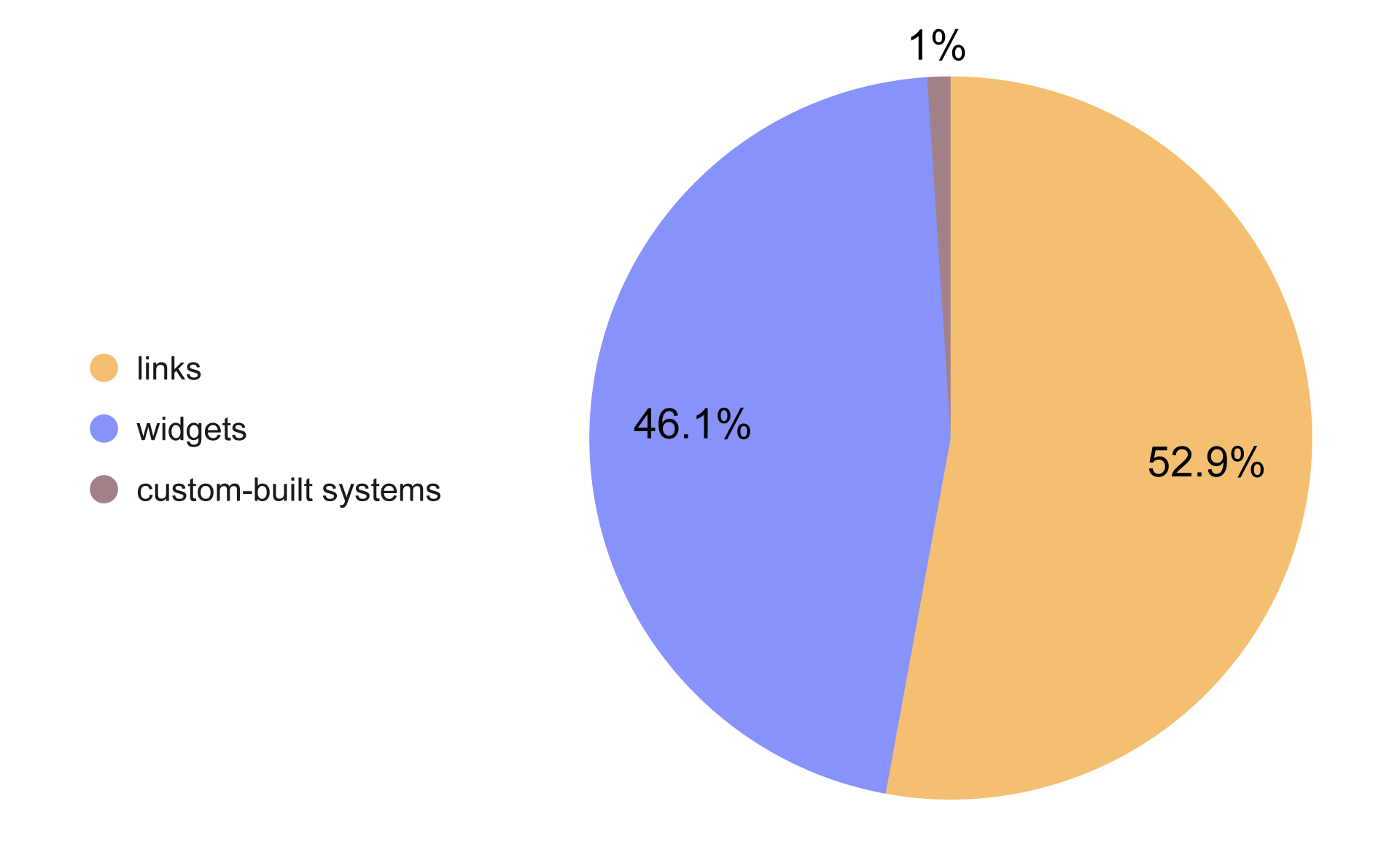
Booking systems by type: external links vs. embedded widgets vs. custom-built
So let’s talk about these options.
Building a custom booking system from scratch? In most cases, that’s unnecessarily complex and expensive. So the real question is: link or widget?
Links are more common, probably because they’re quick and easy to implement. But widgets offer a far better experience — for both users and businesses.
Widgets allow for smoother, more seamless booking. Everything is right there on the page — no confusing redirects, no extra steps. The user completes the process faster, and is less likely to drop off. That means better UX, better conversion rates, and, as a bonus, better SEO and analytics. With widgets, you can track behavior directly on the page and optimize your content around the booking flow. You can fine-tune headers, metadata, and surrounding copy — all of which help boost your site’s visibility and ranking.
So what’s the best booking setup? An embedded widget, directly on your site. And how many businesses actually use that ideal setup? Not many:
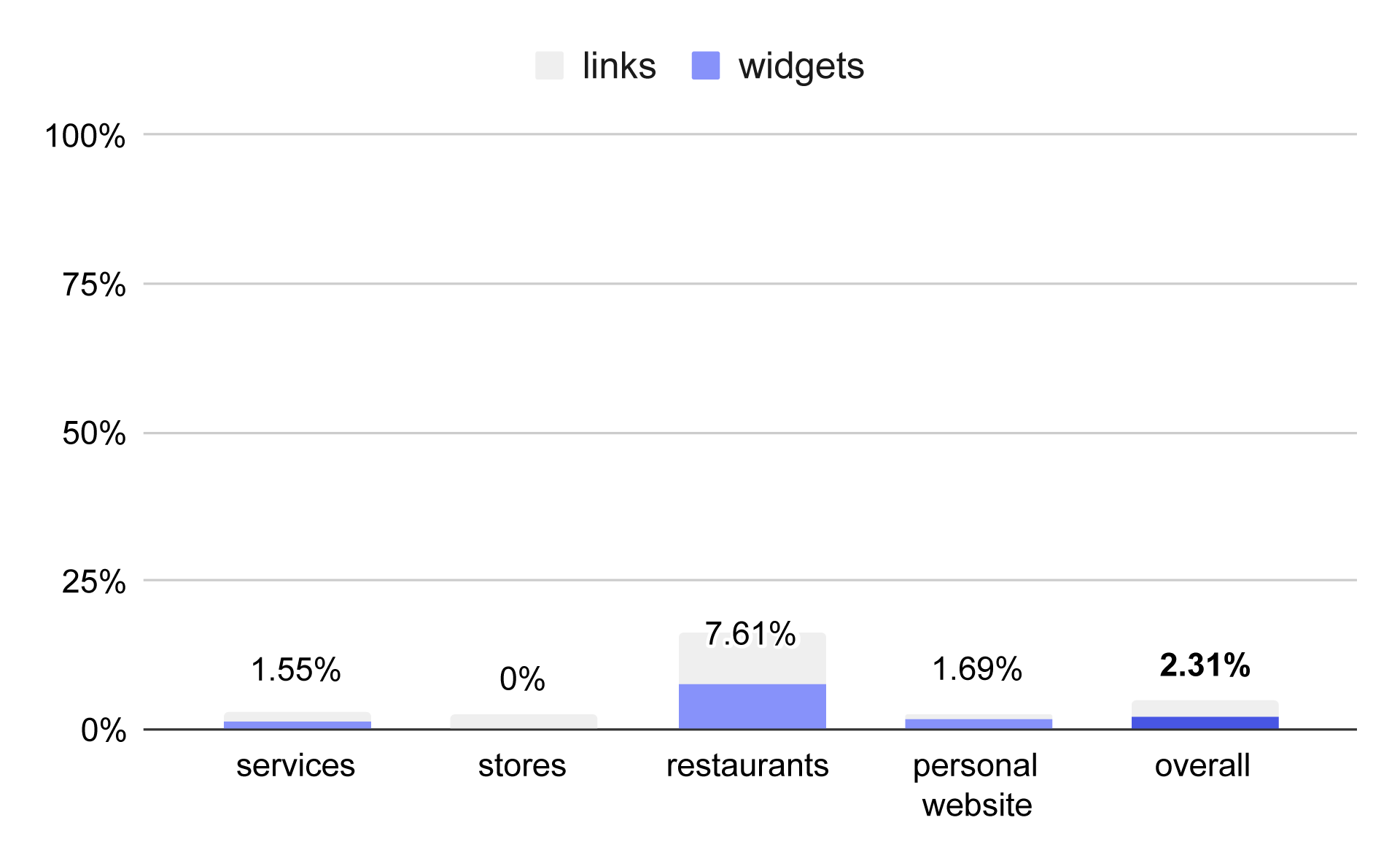
Percentage of business websites with on-site booking widgets
Remember that first chart? These bars are even lower — just 2.31% of the websites we studied gave customers the ability to book services in the most effective way possible.
So why don’t more businesses use a scheduler?
Honestly? We don’t get it either. Online booking is such an easy win — and yet, here we are.
But here’s what it probably comes down to:
👴 They’re used to the old way.
Phone calls, text messages, scribbles in a notebook, maybe the occasional Messenger ping — it’s worked so far, so they don’t see a reason to change. There’s no real push toward digitizing.
💵 They think it’s too hard or too expensive.
Many small businesses still believe job scheduling software is only for big teams or tech-heavy operations. Or they assume setting up a scheduler means hiring a developer, paying for an expensive subscription, and spending hours figuring it all out. The truth? It’s more accessible — and more useful — than ever.
⏰ They don’t feel market pressure — yet.
As long as the competition hasn’t adopted a scheduler, there’s no urgency. But the moment a competitor starts taking bookings 24/7? That’s when the panic sets in.
And you know what that means? It means you’ve got a golden opportunity to get ahead — quickly and easily.
How to actually win with a scheduler?
Let’s recap:
1️⃣ Most users prefer to book services online
2️⃣ ... and yet, only a small fraction of businesses offer scheduling on their websites. Even fewer do it the right way.
4️⃣ A good booking system should match the way your industry works — not force you into someone else’s template.
At this point, you’re probably already mentally scrolling through your top scheduling app options. But before you make a decision — here’s our suggestion: try the scheduler that’s built right into our system. In addition to a modern website tailored for service-based, e-commerce, or restaurant businesses, you’ll get a booking system that includes:
- A smooth booking experience for your clients
- The ability to book with specific team members
- Tools designed for on-location service businesses (field services)
- Appointment confirmations and reminders
Ready to try it out? Just 👉 generate your website 👈 for free and start exploring!
Sources:
- IKOL Research
- 12+ Appointment Scheduling Statistics & Trends - SMB Guide
- Online Booking Options Can Get You More Clients - GetApp
- The US Restaurant Reservation Market Heats Up: Fewer Restaurants, More Competition - analytics.restaurant