Why So Few Field Service Businesses Offer Online Booking?
When we think about modern service delivery, one thing becomes increasingly clear — efficiency isn’t just about doing things faster; it’s about doing them smarter. Whether you run a carpet cleaning company, a plumbing service, or an HVAC repair business, the ability to organize, schedule, and communicate with clients effectively defines your success.
This article explores why field service management remains one of the most challenging areas for digital transformation, why so few businesses in this category use online booking systems, and how adopting the right tools — such as work order management software, field service app, and client management software — can completely change how these companies operate.
What are field services?
Let’s start with a definition:
Field services are tasks performed by technicians or contractors at a customer's location rather than the company’s office — such as installation, maintenance, and equipment repair.
Every one of us has, at some point, needed to call a technician — to fix an appliance, clean a carpet, repair a roof, or handle pest control. And while the service itself takes place at your doorstep, the booking process often doesn’t. There are different ways to order such services remotely: the old-fashioned way (by phone or email) or through a modern booking system embedded directly on a company website.
It might seem like a small difference, but that single interaction — how a customer books a job — sets the tone for the entire client experience. A simple online form can replace multiple phone calls and guarantee the appointment is properly recorded, assigned, and tracked.
How many field service businesses use a booking system?
To understand how digitally mature field service industries really are, we analyzed over 2,600 websites of small service businesses in the United States. We looked for signs of integrated booking systems — anything from simple contact forms that schedule appointments to full-fledged field service management platforms that allow for instant scheduling and payment.
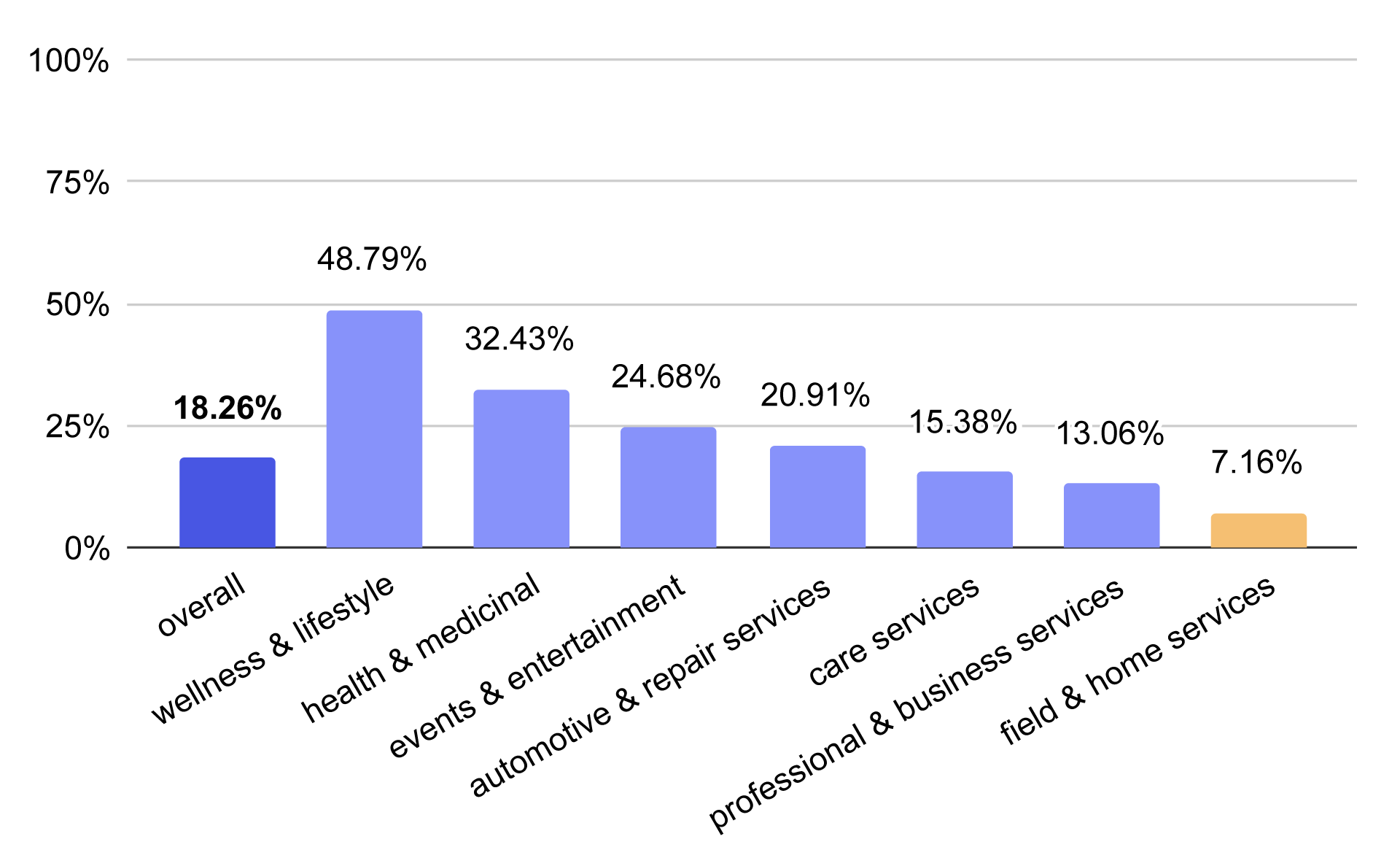
The share of field service businesses with a booking system on their website compared to other service businesses
Across all industries studied, the average share of businesses with an online booking option was 18.26%. That means fewer than one in five service-based businesses in the U.S. let customers schedule appointments directly online.
Here’s how the numbers look when broken down by category:
- Wellness & lifestyle –
48.79% - Health & medicinal –
32.43% - Events & entertainment services –
24.68% - Automotive & repair services –
20.91% - Wellness & personal care –
18.2% - Care services –
16.3% - Professional & business services –
15.38% - Field & home services –
7.16%
That last number is especially striking. Only about 7% of field and home service providers — the people who physically travel to clients’ homes — have online booking. For comparison, industries like healthcare and entertainment, where scheduling is also complex, have adoption rates several times higher.
The data suggests that field and home services are lagging behind, even as customers increasingly expect the convenience of online booking. A major reason for this may be that most of these companies still rely on phone coordination instead of integrating work order management software that automatically handles scheduling, communication, and reporting.
How the nature of field services affects booking?
Not all field service jobs are the same. Some are quick, routine visits. Others are large-scale projects requiring custom planning. And some are urgent emergencies where time is the single most important factor.
Based on these differences, we can divide field service industries into three major categories.
📅 Scheduled & recurring services
These are industries where it’s easy to define what the service involves and roughly how long it will take. Usually, no detailed consultation is needed. You know exactly what you’re buying — and the provider knows exactly what to expect.
Examples include carpet cleaning, pest control, lawn care, chimney sweeping, and power washing. Many of these can also be recurring services — for example, waste management, septic tank pumping, general cleaning, pool maintenance, or window cleaning.
Because these services are repetitive and predictable, they’re perfect candidates for automation and digital scheduling. A well-designed work order management software solution can handle the entire flow — from booking to invoicing — without a single phone call. Combined with dispatching software, it ensures technicians arrive on time, with the right tools, and the right client details already synced from the client management software database.
📋 Project-based services
Here, things get more complex. Every job starts with an assessment, sometimes an on-site visit, followed by a detailed quote and a custom plan. Services are tailored to each client’s specific needs and are rarely repeated in exactly the same form.
Typical examples include general contracting, solar panel installation, well drilling, moving services, and excavation. In these industries, the booking process is more like a consultation request than a fixed appointment. Still, a client management software system can help structure communication, track proposals, and avoid lost leads.
🛟 Emergency & project-based services
Finally, we have businesses that live in two worlds: they handle emergencies but also plan long-term projects. Think plumbers, electricians, elevator technicians, roadside assistance, arborists, and appliance repair specialists.
In these cases, quick response time is everything. A well-integrated field service app lets technicians receive real-time notifications, navigate to job sites, and update job status immediately after completion. Combined with dispatching software, it helps allocate resources dynamically — sending the nearest qualified technician to the job in seconds.
How do these field service types differ in terms of online booking?
When we grouped the businesses according to their work types, clear differences emerged.
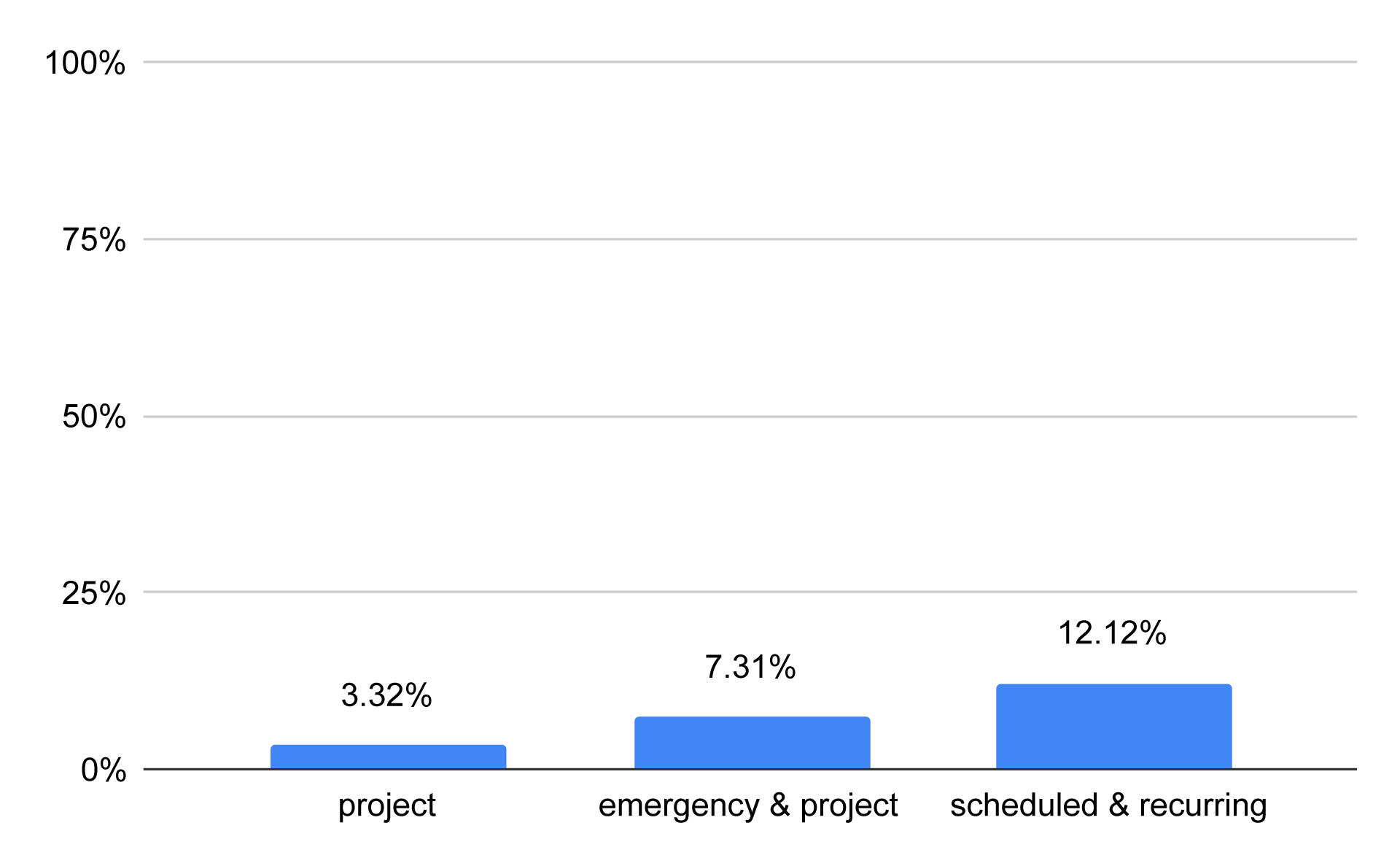
The presence of booking systems across different field service types
Project-based industries had the lowest adoption rate: only 3.32% offered an online booking tool. Their longer sales cycles and custom workflows make one-click scheduling less relevant — but not impossible.
Emergency & project-based industries did slightly better, at 7.31%. The need for fast response times makes automation useful, yet many companies still rely on dispatchers and phone calls.
Scheduled & recurring service providers performed best with 12.12%, but that’s still far below the all-industry average of 18%.
Even among the most predictable service types, online booking adoption remains surprisingly low. So how do these companies actually manage their scheduling if they’re not using online booking?
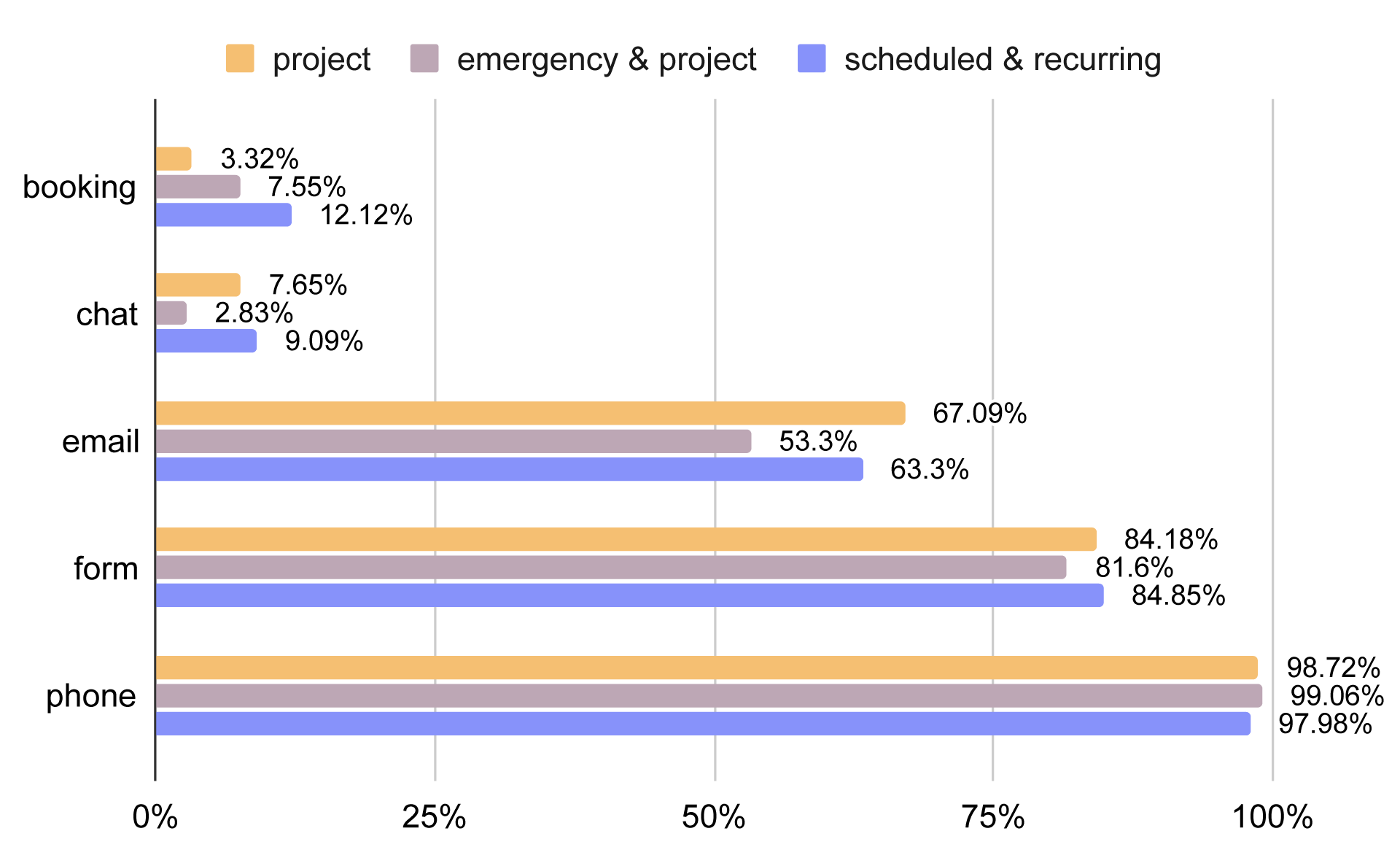
Offered booking options on websites of different types of field service businesses
The short answer: manually — through phone calls, emails, and, in many cases, physical notebooks or spreadsheets. Owners often prefer direct communication, believing it helps “qualify" customers and avoid misunderstandings. But this approach doesn’t scale well. When work gets busy, phone lines jam, messages go unanswered, and technicians end up wasting time coordinating instead of working.
Depending on how each company organizes its workflow, some rely more heavily on written communication. Project-based industries, for example, tend to offer email, chat, and contact forms more often than emergency services — which makes sense, as they deal with more complex requests.
But customer expectations are changing fast. In today’s on-demand economy, consumers are used to booking everything — from haircuts to car rentals — in a few clicks. And field services, despite their operational differences, are not immune to these expectations. Businesses that use field service management software can meet those expectations effortlessly by allowing clients to choose time slots, provide service details, and receive confirmations without waiting on the phone.
What do customers prefer?
Are these habits really shaped only by industry specifics — or do they also reflect what customers actually prefer? According to the GetApp Online Booking Survey:
67%of respondents said they would choose to book online if multiple booking options were available, compared to only22%who would choose to book by phone.
That’s a massive gap. It means that businesses relying solely on phone calls are missing out on a majority of potential clients who simply prefer digital interaction.
Interestingly, customers also reported higher satisfaction when they could book at any time — not just during office hours. For field service providers, this could be a competitive advantage: letting customers schedule jobs 24/7 while the system automatically manages availability and travel time.
Booking in field services — why it’s complicated
Let’s take a closer look at what’s required to make online booking for field services truly functional. There are two main components: reservation logic and communication management.
📝 Reservation
In a field service context, booking involves more than selecting a date and time. The client must describe the problem in enough detail for the technician to come prepared — ideally through a short, structured form. A good work order management software can include custom questionnaires that automatically collect all necessary data before confirming a job.
The system also needs to gather address and access details, such as parking availability, entry codes, or floor number. These details may seem small, but in daily operations they can save hours of wasted time.
Distance and travel time matter too. A good dispatching software should prevent scheduling jobs too far apart, ensuring technicians can travel efficiently between appointments.
🗪 Communication
Once the booking is confirmed, communication becomes the next challenge. The technician needs real-time notifications on their phone or tablet. The client should receive a tracking link to follow technician progress — similar to how delivery apps work.
A modern field service app also allows technicians to upload photos, documentation, and signatures from the job site. The system then automatically updates the job status, sends confirmation messages, and even generates invoices.
The entire experience feels seamless for both sides — but only when all these components work together through a central work order management software system connected to client management software.
Why so few field service businesses use booking systems?
The low adoption of booking systems among field service companies may be partly due to a misconception: that integrating booking requires expensive or complex infrastructure.
In reality, what these businesses need isn’t just a booking form — it’s an integrated work order management software solution.
A booking request in a field service context immediately becomes a work order, which must then be tracked, assigned, and completed. This means that effective booking must be connected to:
- Work order management software for scheduling and job assignment
- Client management software for tracking interactions and history
- Field service app for navigation, job completion, and updates
- Dispatching software for optimizing routes and technician allocation
When these systems work together, booking stops being a manual coordination nightmare and becomes a seamless part of daily operations.
The role of work order software in field service management
Implementing work order management software is often the turning point for growing field service businesses. It connects all the moving parts — booking, scheduling, dispatching, and billing — into one coherent workflow.
Instead of juggling between phone calls, text messages, and paper notes, teams can:
- Automatically convert booking requests into structured work orders
- Assign technicians based on proximity, availability, and expertise
- Monitor real-time progress via a field service app
- Send automatic updates to customers about arrival times or job completion
- Generate invoices immediately after the job, keeping accounting transparent
A good client management layer also helps track repeat customers, service history, and special requests. Over time, this builds a database of loyal clients who can be re-engaged with seasonal offers or maintenance reminders — all automated through the work order management software ecosystem.
How field service management software can help
While field and home service businesses have been slow to adopt online booking, the reason isn’t lack of demand — it’s the operational complexity behind their services. A simple booking form isn’t enough.
What they really need is an integrated solution to handle every stage of the customer journey: from booking and dispatching to payment and feedback.
Businesses that make this shift gain:
- Fewer scheduling conflicts and faster response times
- Better communication between office staff, technicians, and clients
- Greater transparency through real-time tracking
- Higher customer satisfaction and more repeat business
As digital transformation continues to shape customer expectations, it’s only a matter of time before work order management software becomes standard in every service-based business. Those who adopt it early won’t just save time — they’ll win customers, trust, and long-term loyalty.
The data and statistics presented in this blog post come from a research study conducted by IKOL between 2023 and 2025. To learn more about IKOL research methodology and explore other findings, visit: ikol.com/research