Why Skipping Class Booking Software Could Hurt Your Group Classes Business?
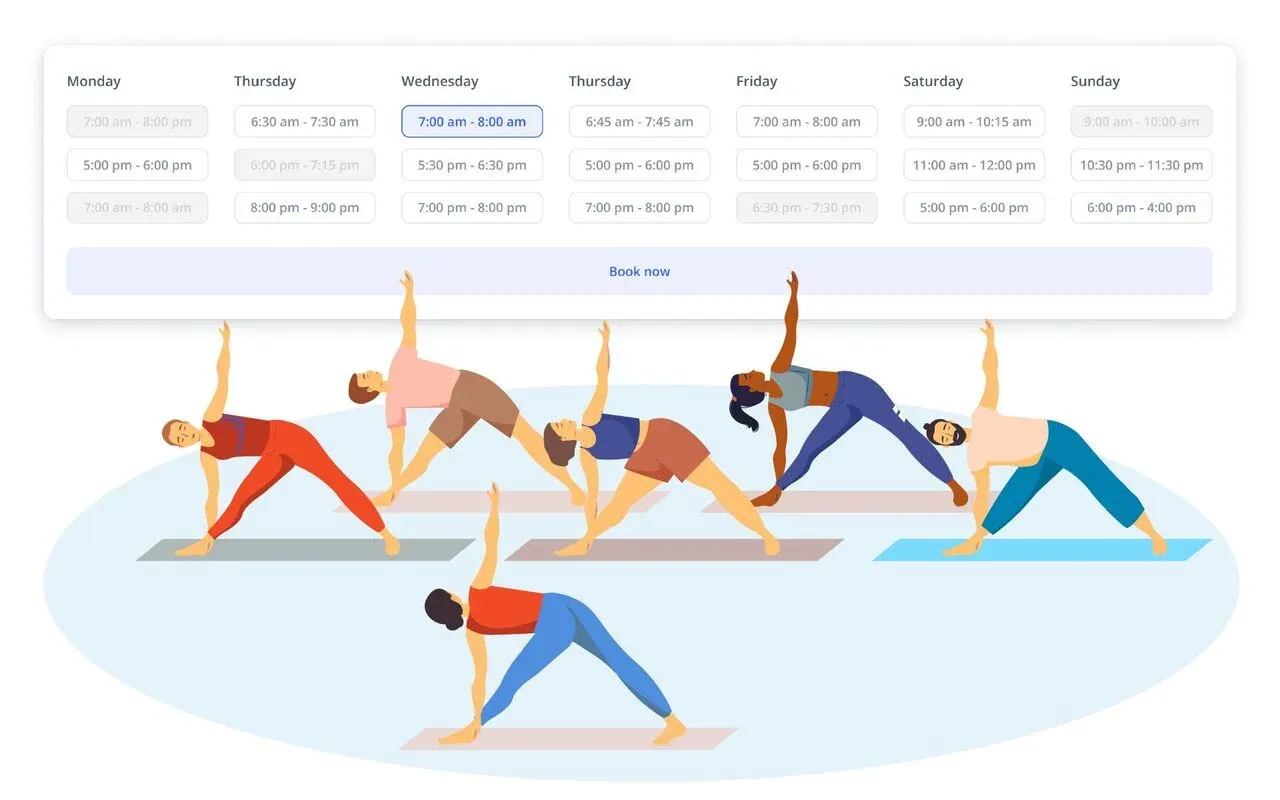
Group classes are where small service businesses really come alive. Whether we’re talking about yoga studios, dance schools, martial arts academies, art workshops, or music lessons - running classes in groups creates community, boosts motivation, and gives businesses a predictable, recurring structure.
But here’s the catch: Group exercise classes also generate a huge amount of logistical work. Managing sign-ups, tracking attendance, communicating cancellations, monitoring class limits, maintaining waitlists, handling payments — it can absolutely drain hours out of a business owner’s week. This is exactly why class booking software is no longer just a convenience. For many group-based businesses, it’s a necessity.
Before we get to the impact of booking systems and what features are essential, let’s start with the basics: what exactly counts as group classes — and what doesn’t?
Group classes — what are they really?
Everyone understands the general idea, but if you want to analyze group exercise classes from a business and operations perspective, it helps to break them into meaningful categories.
There are two main ways to differentiate group classes. Let’s start with classification based on structure:
🔓 Open class / Drop-In
These classes follow a fixed schedule, for example, on Mondays, Wednesdays, and Fridays at 6:00 PM, regardless of attendance numbers. Anyone can join whenever, without prior experience or any attendance history, and the groups change from session to session, making this format particularly accessible to newcomers. Such group exercise classes are especially popular in fitness studios. The open class model significantly lowers the barrier to entry and increases accessibility, but it also introduces a degree of unpredictability. Without a system to enforce capacity limits, it is easy for a room designed for 12 participants to end up accommodating 25, creating organizational chaos and diminishing the overall experience for attendees.
🔒 Closed course
A closed course operates in direct contrast to the drop-in model. In this format, the same group of participants starts and finishes the program together, following a predefined curriculum or progression, such as an eight-week salsa course. Midway entry is not permitted, and participants are required to enroll in the entire program from the beginning. The key advantage of this approach lies in fostering higher commitment and providing greater stability for both instructors and students. The downside, however, is that it demands careful enrollment management, particularly at the start of each cycle, to ensure that all participants are properly accounted for and the program runs smoothly.
This was a classification based on the structure of group classes. Another important distinction is based on how payments for the classes are organized:
💸 Pay-Per-Class
In this model, clients pay for each individual session. This approach offers maximum flexibility and lowers the barriers to commitment, making it particularly well-suited for open classes. However, it also leads to significant fluctuations in attendance, which makes class booking software essential for tracking sign-ups, managing class limits, and handling cancellations efficiently.
🪪 Memberships / Open pass programs
This format involves a monthly or recurring subscription, providing access to a selection of group exercise classes from a larger pool. It can include a mix of open and semi-closed classes, with either a fixed entry limit, such as eight classes per month, or unlimited access. For businesses using memberships, class booking software becomes the central hub for managing each client. It must track remaining entries, handle renewals, enforce program rules, and accept recurring payments automatically to simplify membership management.
What we do not count as group classes
To keep the definition clean, we exclude one-off service events that don’t run cyclically — e.g., a company hiring a business training provider to deliver a workshop for their employees. That’s a one-time service, not a recurring group class.
How many group classes use a booking system?
We conducted a study on over 2,600 small service businesses in the U.S. From these, we isolated businesses offering group classes in the following industries:
- Art lessons
- Dance classes
- Martial arts
- Music classes
- Yoga classes

Group class businesses: Presence of a booking system on their website vs. no booking system
Slightly more than half of these businesses — around 53.59% — had a booking system embedded on their website, while the remaining 47.41% did not. But is that considered high or low? To put it into perspective, let’s compare these figures with other sectors.
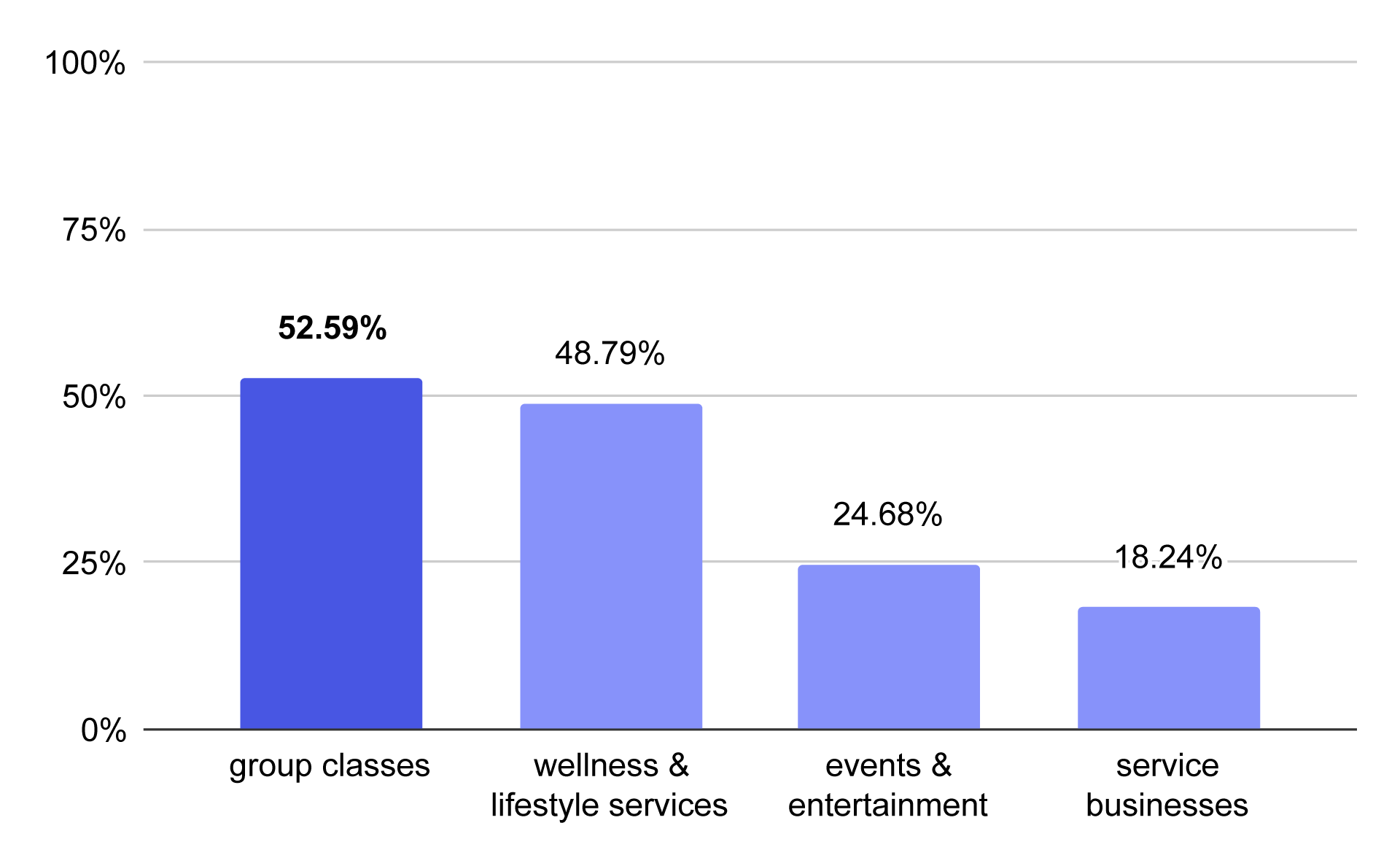
Booking system adoption on websites: Group classes vs. wellness & lifestyle, events & entertainment, and service businesses overall
The industries we studied are part of the broader categories wellness & lifestyle services and events & entertainment.
Here’s how booking adoption looked:
- Group classes:
52.59% - Wellness & lifestyle:
48.79% - Events & entertainment:
24.66% - All service businesses combined:
18.24%
This means one thing: Group-class businesses are clearly leading the market in booking system adoption — and it makes perfect sense when you consider the operational complexity behind classes.
But let’s break it down further.
How does the structure of group classes influence booking methods?
Now let’s go deeper and analyze each industry individually.
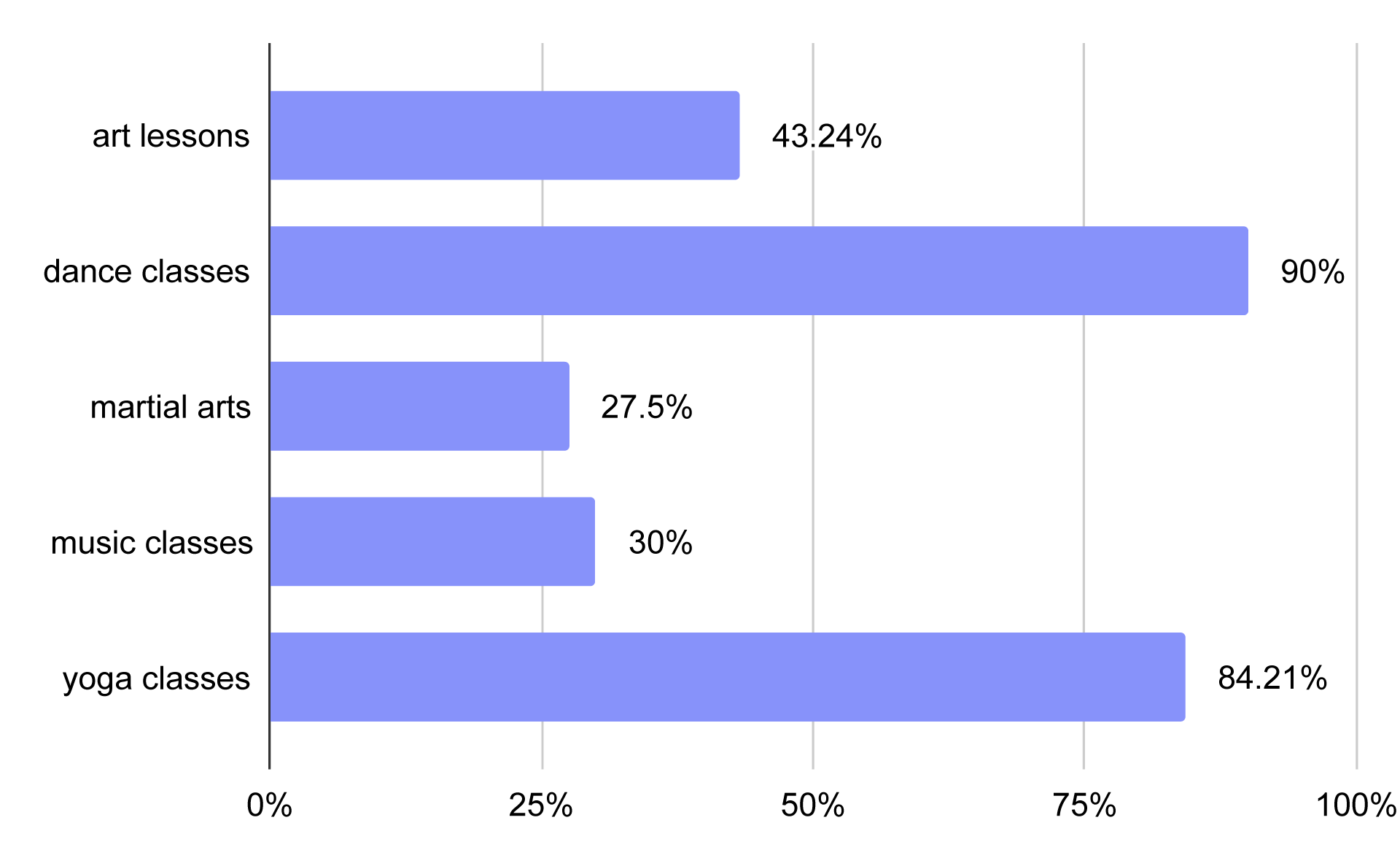
Booking system presence across different group-class industries
Here’s what we found: adoption of booking systems varies significantly across different types of group-class businesses. About 90% of dance classes had a booking system on their website, while yoga classes were close behind at approximately 84%. In contrast, only 43% of art lessons, 30% of music classes, and 28% of martial arts schools had an online booking system in place.
Quite a difference, right? But why is that? There are two key reasons:
- Open classes with pay-per-class models require real-time booking. Dance and yoga classes are a perfect example: they are drop-in friendly, feature variable group sizes, and experience high demand for instant sign-ups.
- Closed courses do not always require an online booking system. For instance, martial arts schools often operate with fixed groups — once a student is enrolled, they simply attend each session, so there is no need to “book a spot" for every class.
Finally, businesses that rely heavily on memberships often use internal systems tied to client accounts rather than public booking widgets on their website. While these systems technically function as booking platforms, they may not be visible or accessible to the general public.
If not a booking system on the website, then what else?
Not every group-class business has an online booking system on their website. So what do they use instead?
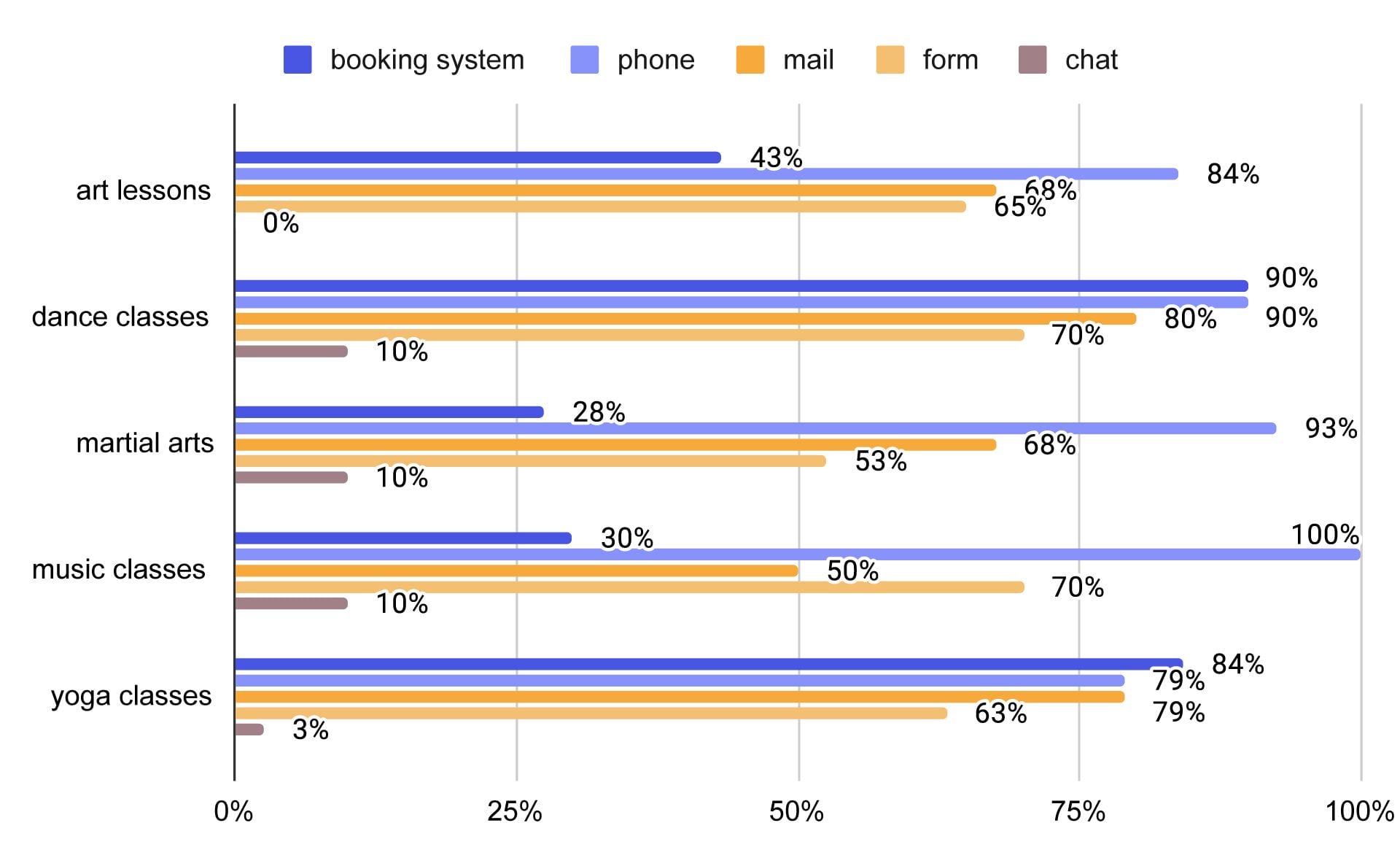
Other booking methods used by group-class businesses
When we looked at industries with low adoption of online booking, a clear pattern emerged: most still rely heavily on phone calls as the main way for clients to sign up. Phone bookings remain the default, old-school method for managing registrations.
The one notable exception is yoga studios, where online booking has actually overtaken phone contact. This shift toward digital booking is likely driven by several factors: strong competition in the market, a growing expectation of convenience from clients, larger class sizes with high turnover, and an already established culture of online booking within the wellness sector.
Beyond the high percentage of websites listing a phone number as the main contact option, it’s worth noting that very few businesses use website chat as a way to communicate with clients. This raises an interesting question: is this a genuine preference among business owners, or has the group-class industry simply not yet adapted to the evolving expectations of the market? Either way, it represents a clear opportunity for businesses to get ahead of the competition by adopting more modern, digital communication tools.
What features should a booking system for group classes have?
Before diving into the specifics, let’s be clear: group classes are one of the most operationally complex service models. A good class booking software should reduce chaos, not add to it.
Here’s what it absolutely must do:
📊 Control maximum capacity per time slot. This is non-negotiable. Without a system in place, overbooking becomes a real risk, leading to unhappy clients and frustrated instructors.
❌ Allow cancellations and manage attendance. People cancel — frequently. A proper system provides a structured, trackable, and automated way to cancel spots, open them up for others, notify instructors, and enforce rules such as late cancellation fees.
🔄 Client accounts and recurring logic. Essential for businesses with memberships, passes, or semi-closed/progressive classes, client management software should track attendance history, manage renewals, and monitor credit balances — essentially acting as the central hub for client management.
📱 Online Payments. Not required for every business model, but crucial for open classes and pay-per-class setups. The system should also allow you to accept recurring payments seamlessly. Integrating payments directly into your booking system saves time and reduces errors.
🔔 Reminders. A simple automated appointment reminder system within client management software can drastically reduce no-shows, improving attendance and customer satisfaction without any extra effort.
Why a booking system is essential for group-class businesses?
Running group classes without class booking software is like running a restaurant without knowing how many people are coming for dinner.
Automates complex organizational work
Managing group sizes, class limits, attendance, cancellations, communication, and payments manually is exhausting and error-prone. Using client management software can streamline all of these tasks efficiently. A good booking system can reduce hours of work per week to just minutes.
Boosts conversions
Customers expect fast, convenient booking. If your competitor allows a class to be booked in 10 seconds, and you require a phone call or manual message, you’re losing clients before they even enter your door. Convenience drives conversions, and combined with automated appointment reminders, this ensures clients actually show up.
Master Your Group Classes with Class Booking Software
Group classes are a powerful business model, but they come with demanding operational complexity. The data shows that industries offering group classes are among the most advanced in adopting booking systems, with dance and yoga leading the charge. And it’s no surprise — when your entire business depends on organized, repeatable group sessions, class booking software isn’t a luxury. It’s the backbone of smooth operations.
A good booking system:
- manages class limits
- handles cancellations
- automates communication
- supports memberships and payments
- boosts customer convenience and conversion
And — surprise — all these features (and more) are exactly what we offer in our software.
If you run group classes and want fewer headaches, fewer messages, fewer scheduling mistakes — and the ability to easily accept recurring payments — our client management software with built-in appointment reminders can help you get there. 👉Try it for free today!👈
The data and statistics presented in this blog post come from a research study conducted by IKOL between 2023 and 2025. To learn more about IKOL research methodology and explore other findings, visit: ikol.com/research