How to Start Blogging as a Small Business Owner in 2026?

Many small business owners know that they should be doing content marketing, but in the rush of their everyday responsibilities, they usually manage to do little more than publish an occasional post on their company’s social media. Running a blog often falls to the bottom of their priority list, and many people wonder whether it is really necessary and what it can actually do for their business.
In this post, we will answer all the questions a small business owner might have about running a blog. We will also share data we collected by analyzing more than 3,000 small business websites from the US.
But first, let’s start with the most pressing question:
Why should a small business run a blog?
Running a blog as a small business is part of a broader business growth strategy. By increasing your online visibility and building trust through the content you publish, you can grow your business.
👤 To attract more leads and customers
Blogging can become one of the key elements of your SEO strategy. When you no longer need to expand or improve the copy on your main website pages, but still want to increase your visibility in search results, it is time to start building a blog.
🤝 To build trust
A blog is one of the elements that helps create a professional business image. It demonstrates your expertise, shows your commitment, and highlights that your business is focused on helping customers.
📣 To generate content for other marketing channels
Running a blog works synergistically with other types of marketing activities. Once you create a blog post, you can repurpose and adapt the content you have already produced for other channels, such as social media or email campaigns.
All of these goals can be summed up in one word: scaling your business. And when you scale a business, you should be prepared not only for higher revenue but also for more work. That is exactly what starting a blog requires - an additional investment of time and effort. Blogging is a specific way of scaling because it requires a long-term strategy and consistency to deliver results.
How many small businesses actually have a blog?
Not many - only 18.9%. And if we look only at blogs that are still actively maintained, this number drops to 10.02%.
But let’s start from the beginning. As mentioned above, our research showed that 18.9% of small business websites in the US have a blog. However, business websites are not a single, uniform group - after dividing them into different types, we found the following results: 21.43% of service businesses, 18.72% of online stores, 4.15% of restaurants, and 15.97% of portfolio websites had blog posts on their websites.
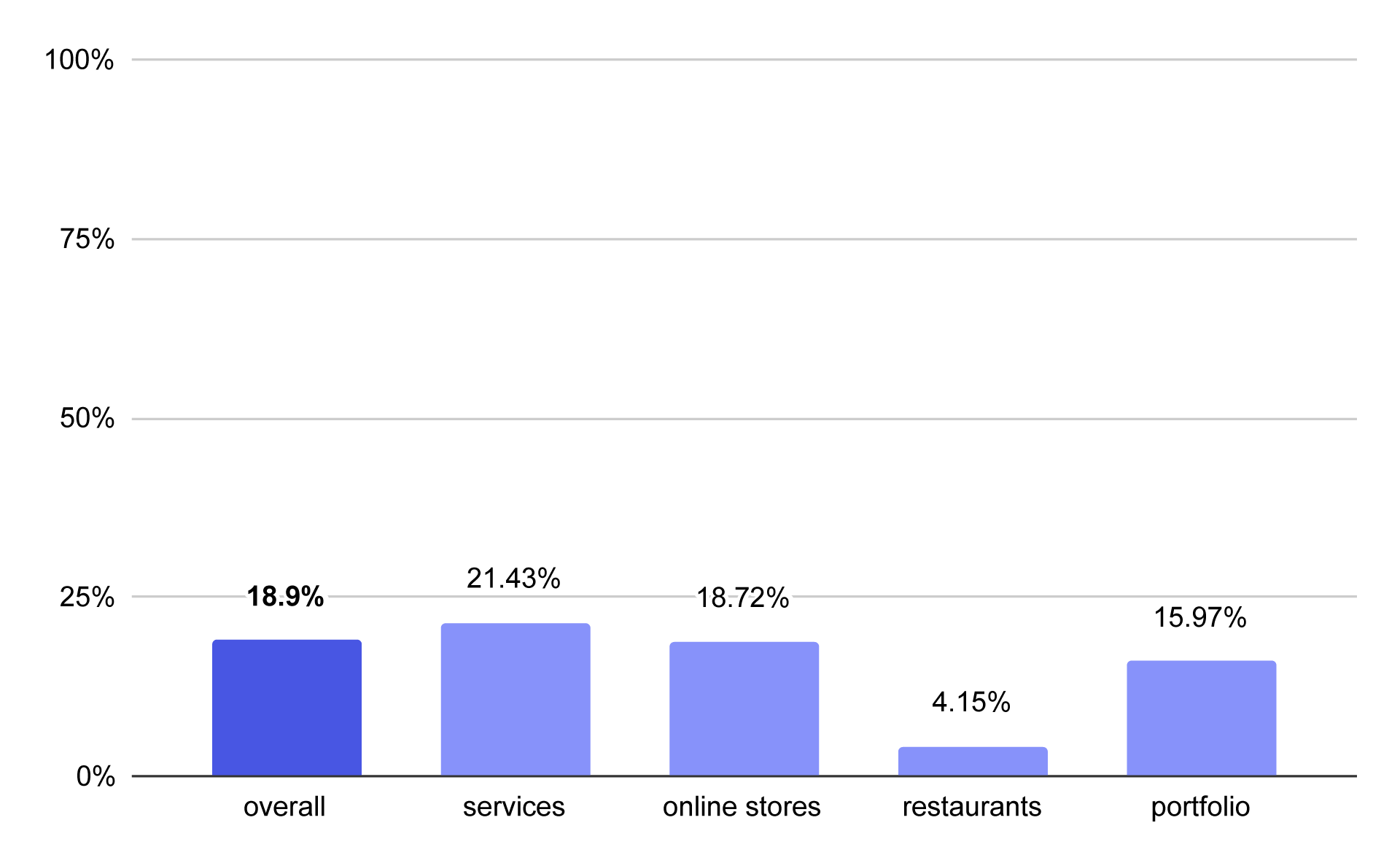
Share of small business websites with a blog
But having blog posts on a website is one thing - actively maintaining a blog is another. We looked at the dates of the latest posts and compared them with the publishing frequency. It turned out that a large portion of these blogs had been abandoned.
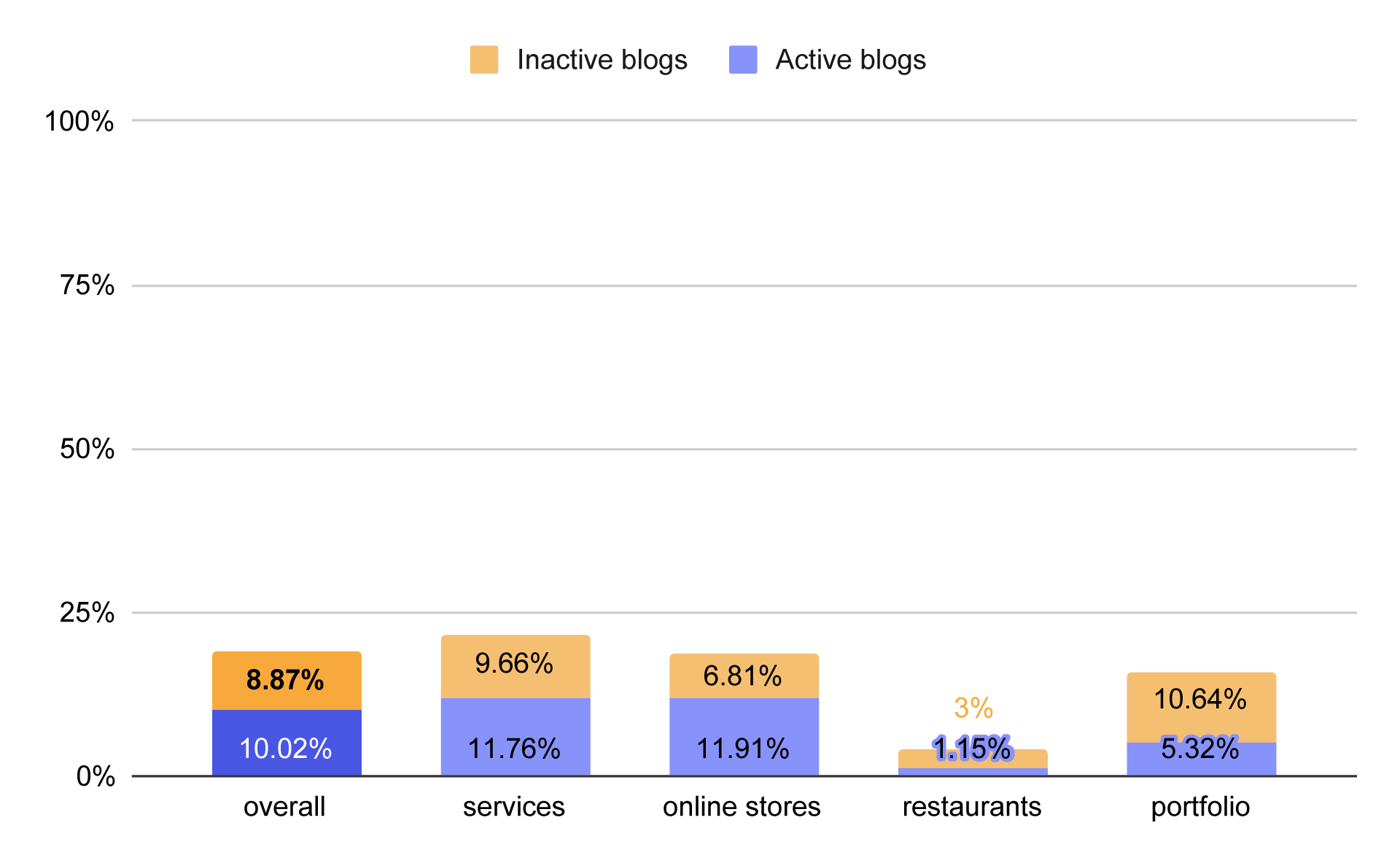
Share of small business blogs that are active vs. inactive
We found genuinely active blogs on 10.02% of all analyzed websites. Among service business websites, 11.76% had an active blog, while the number was 11.91% for online stores, 1.15% for restaurants, and 5.31% for portfolio websites.
These are relatively low numbers, but one result stands out: the exceptionally low presence of blogs on restaurant websites. This may be related to the way customers discover restaurants - through maps or food delivery apps rather than traditional search engines. People are much less likely to find a restaurant through a simple Google search.
Why do many blogs fail?
Running a blog for a business website can fail for one or several reasons: lack of strategy, lack of consistency, or poor-quality content.
🧭 Lack of strategy
To do something effectively, you need to know:
- What you want to achieve
- How you want to achieve it
- What you need to do to achieve it
- And, of course, you need to stay consistent in your efforts.
Some businesses start blogging without answering these questions beforehand, driven only by a vague belief that a blog will somehow benefit their business. As a result, they publish a few posts, run out of ideas, struggle to find the time, don’t see any results, and eventually abandon the initiative altogether.
📆 Lack of consistency
This is often a consequence of the previous point - the lack of a plan and failure to allocate time for regular publishing.
One or two blog posts will not significantly impact your website, and they will not make your business look more professional. Instead, they will look exactly like what they actually are: an abandoned idea. And unfortunately, that does not create a professional impression.
👎 Not providing real value
This can be broken down into two factors:
- Lack of SEO value - posts that are difficult for search engines to understand or that are published on websites with technical issues will struggle to gain visibility.
- Lack of value for visitors - content written only for search engines, without actually helping people who are looking for solutions to their problems.
So how can you avoid these mistakes and use blogging to gain an advantage over your competition?
How to start blogging as a small business?
First of all, you need to define your strategy. You don’t need to set goals here - we already covered the goals in the “Why should a small business blog?" section. When creating your strategy, it is worth following these points:
- Start by answering the question: who is your target customer, and what would they like to learn? This will be your starting point for finding content topics (more on that later).
- Establish a realistic publishing schedule and set aside time for writing blog posts in your own or your team’s schedule. Alternatively, you can outsource it to a marketing agency, although we understand that as a small business, you may not have the budget for that.
- Optimize every post for conversions by adding CTAs that match the topic of the article.
- Promote your posts through other marketing channels you use: newsletters, social media, and more.
- Regularly measure the results of your efforts and draw conclusions from the data.
With a solid strategy and the discipline to follow it, you can unlock the true business potential that blogging has to offer.
How often should a small business blog?
Blog as often as you can while maintaining high quality and consistency. This, of course, depends on the size of your team and the amount of time you can dedicate to content creation. It is better to publish one high-quality blog post per month than to post every week at the expense of quality.
Search engines value fresh content and consistency. Visitors value high-quality content. To achieve the best results, you need to find the right balance between these two factors.
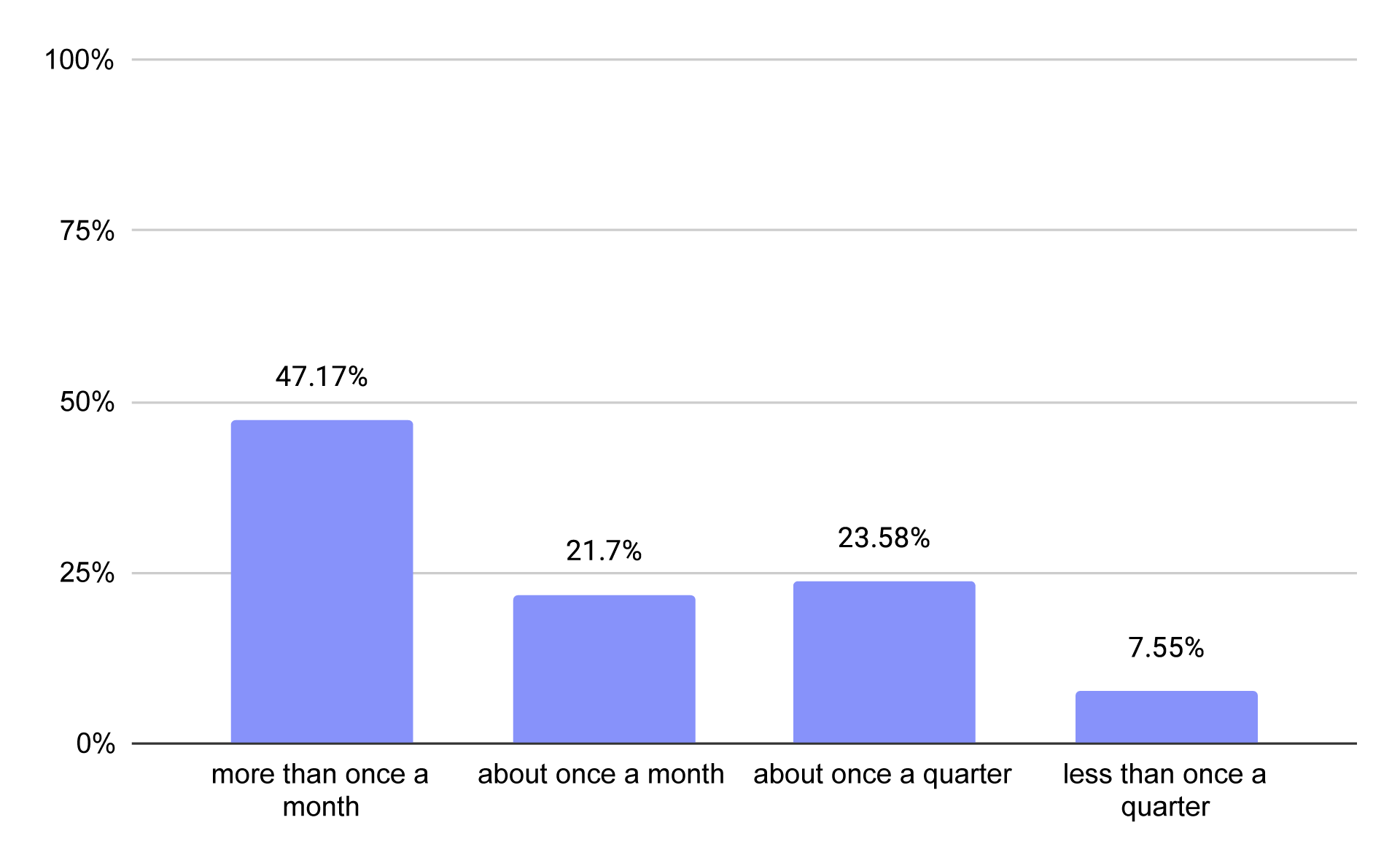
Blog publishing frequency among small business websites
Among US small business websites that have blogs, we observed the following distribution of publishing frequency:
- More than once a month:
47.17% - Approximately once a month:
21.7% - Approximately once a quarter:
23.58% - Less frequently than once a quarter:
7.55%
Is it worth updating blog posts?
Definitely. Value does not come only from creating new content - sometimes it is worth refreshing an already published post that performs well by adding new information and making improvements. This can give it a small boost in search rankings and ensure that it remains just as useful as it was when it was first published.
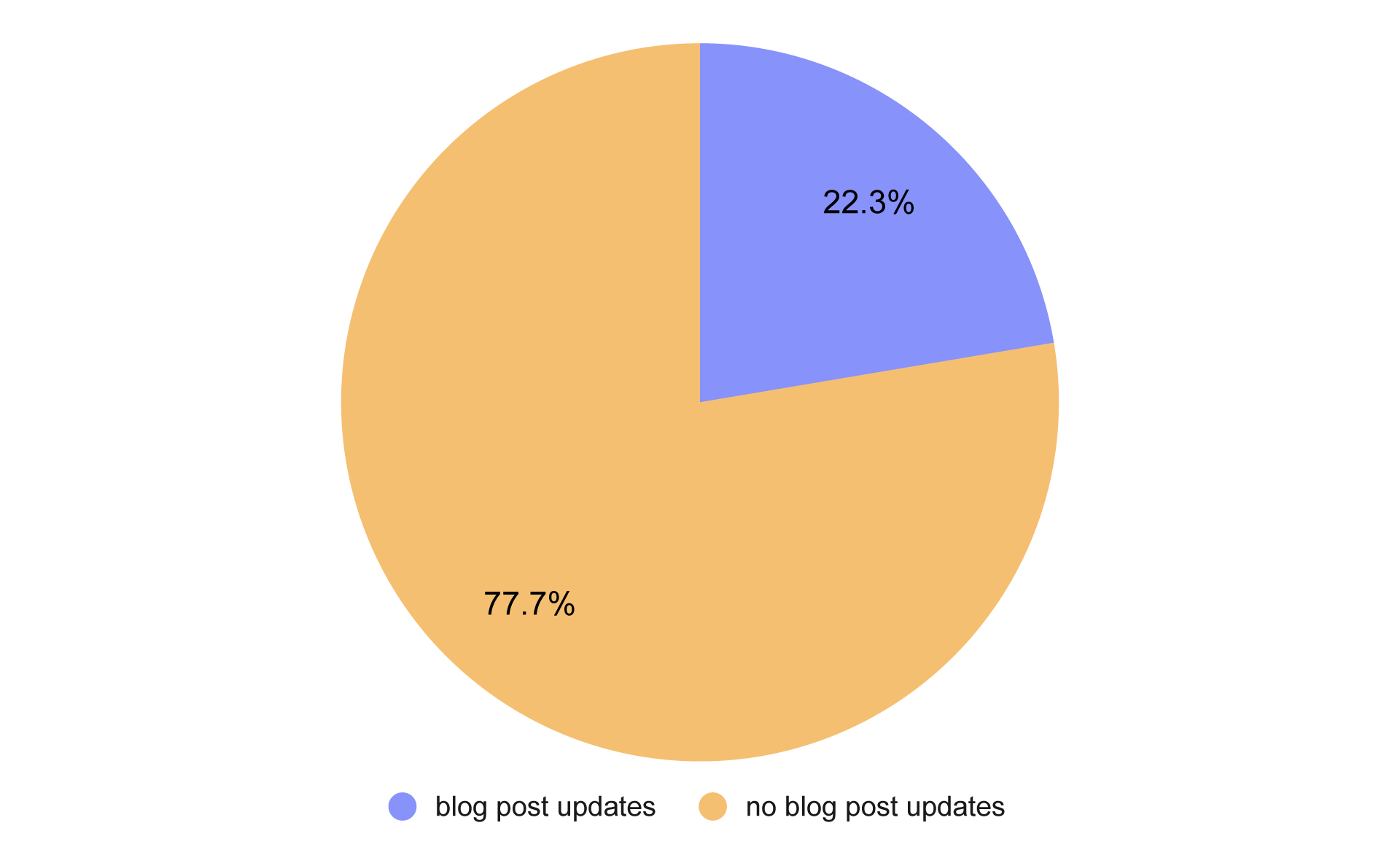
Percentage of small business blogs that update existing posts
Among the small business websites we analyzed that had blogs, we found that 22.3% update their existing blog posts, while 77.7% do not.
How should a small business write a blog?
Write your blog primarily with the reader in mind, not search engine crawlers. After all, the goal is to attract customers, not just to appear in search results.
Organic SEO is a broad topic though, and if you don't know where to start, check our guide to organic SEO: How to Do SEO Yourself? A Practical Guide to Organic SEO
What topics should you write about?
The best blog topics answer real customer questions. If a customer has asked you a question in person, over the phone, or by email, there is a good chance someone else is searching for the same answer online.
However, you should also consciously choose the keywords you create content around. They should be both closely related to your offer and realistic in terms of competition.
The approach looks slightly different for local businesses and businesses that are not limited to a specific geographic area. An online store shipping products nationwide will need to follow a different strategy and invest more in SEO than a local auto repair shop, whose customers will naturally come from a relatively small area.
This is one of the advantages of local businesses - because the competition is often smaller, it is easier to do local SEO by yourself. You can learn more in our guide: How to Do Local Search Marketing and Outrank Your Local Competition
Should you use AI to write blog posts?
Of course - as long as you use it as a tool, not as a replacement for your knowledge and experience.
AI can help you research topics, create outlines, organize your thoughts, improve drafts, or turn rough notes into a structured blog post. For a small business owner with limited time, it can make blogging much more manageable.
This approach is called AI-assisted writing and it is a great fit for small business owners who have limited time but valuable expertise and a unique perspective to share.
So yes, use AI for blogging. Just make sure the expertise still comes from you.
Should a blog have categories?
Yes. Categories help both users and search engines understand the structure of your content.
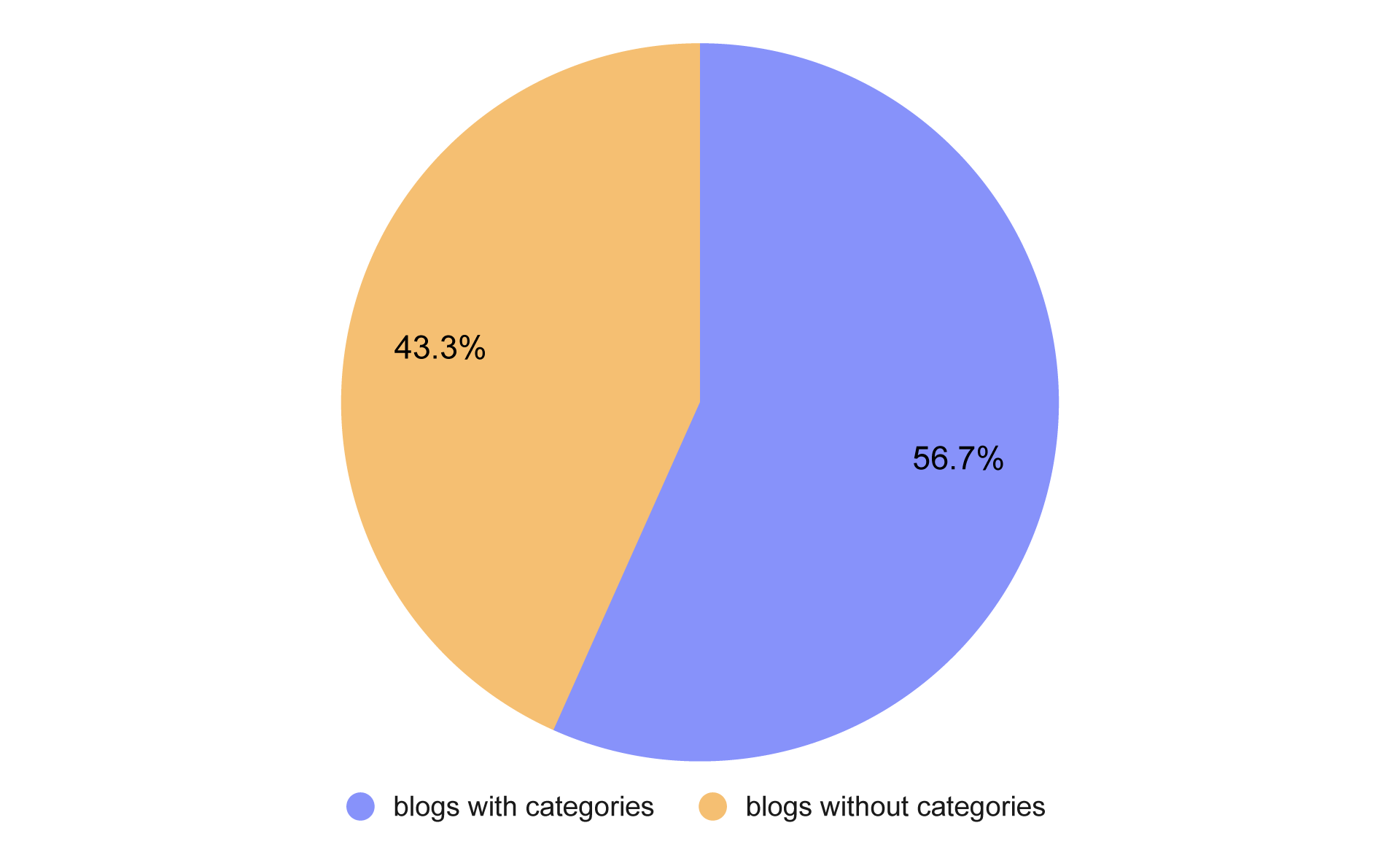
Percentage of small business blogs with categories
Among the small business websites we analyzed that had blogs, we found that 56.7% organize their blog posts into categories, while 43.3% do not.
Should a blog list an author?
Yes. Showing an author helps build trust with readers, and it can also have an impact on SEO.
Google pays attention to E-E-A-T (Experience, Expertise, Authoritativeness, Trustworthiness) when evaluating content quality. Additionally, AI Overviews look for reliable sources when selecting content to reference. Having a clearly identified author on a blog post can contribute to greater trust in the content and increase the chances of it being cited and linked as a source.
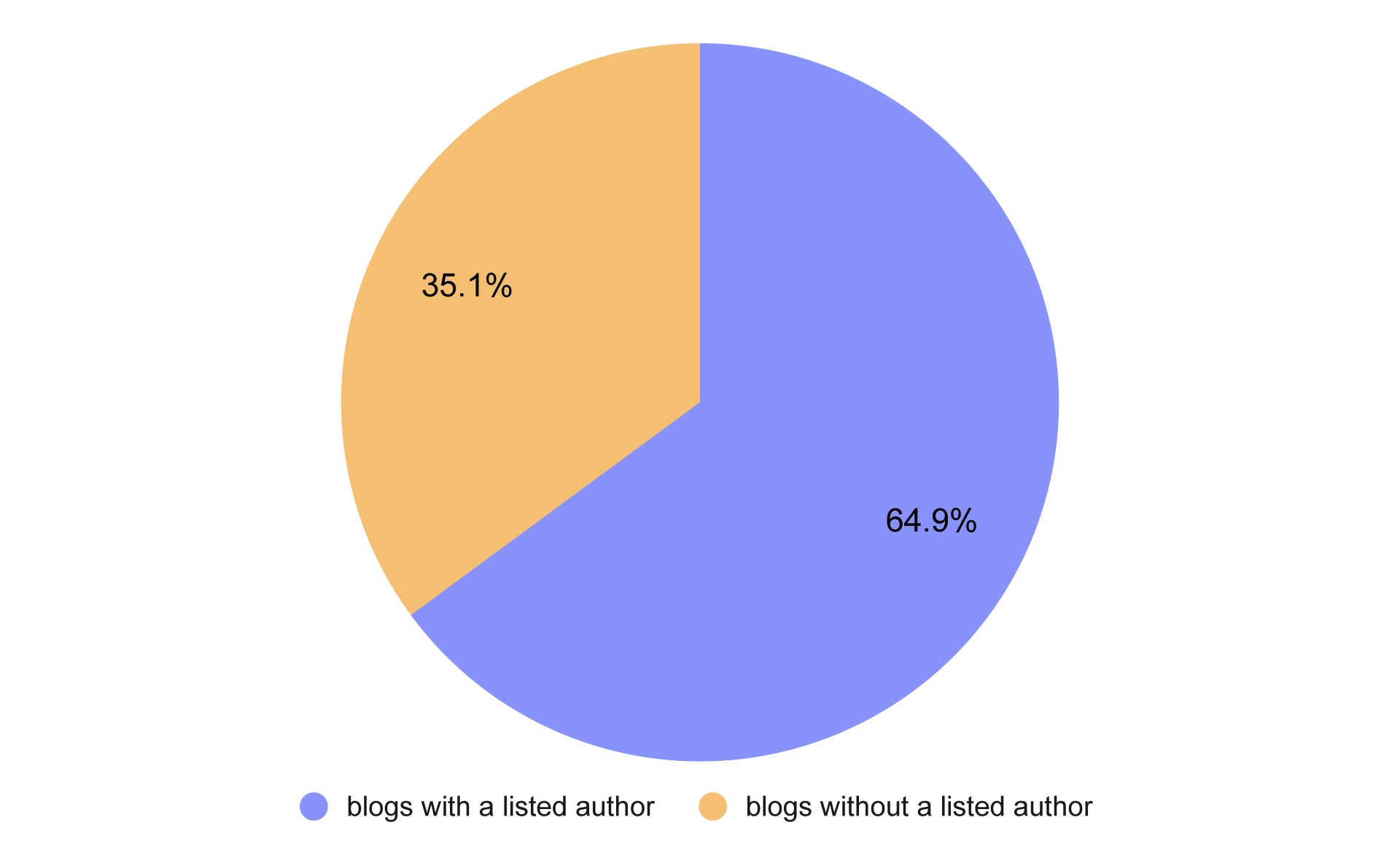
Percentage of small business blogs with a listed author
Among the small business websites we analyzed that had blogs, we found that 64.9% include the blog post author, while 35.1% do not.
Should a blog post include visual content?
Yes. Elements such as images, charts, and videos increase user engagement, encourage visitors to spend more time on the page, and make the content easier to remember.
A blog post should include at least one visual element - the featured image. Without any visuals, there is a much lower chance that visitors will remember the content or feel encouraged to explore the website further.
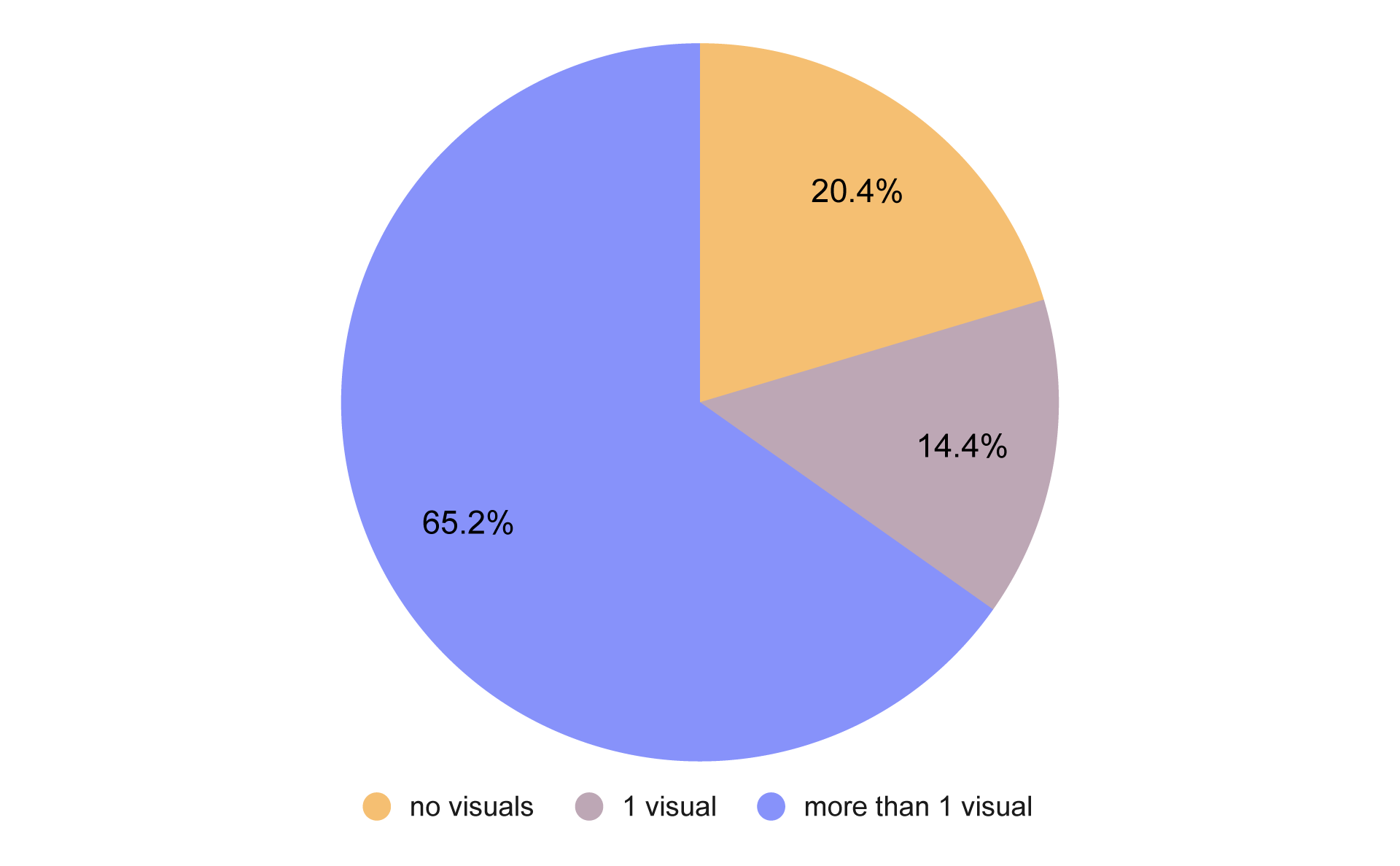
Distribution of Image Count in Small Business Blog Posts
Among the small business websites we analyzed that had blogs, we observed the following distribution:
20.4%had no visual content in their blog posts14.4%had one visual element65.2%had more than one visual element
Visual content can also include videos. Not only can videos encourage visitors to spend more time on the page, but they can also be a great way to build reach on other platforms if they are embedded from sources such as YouTube.
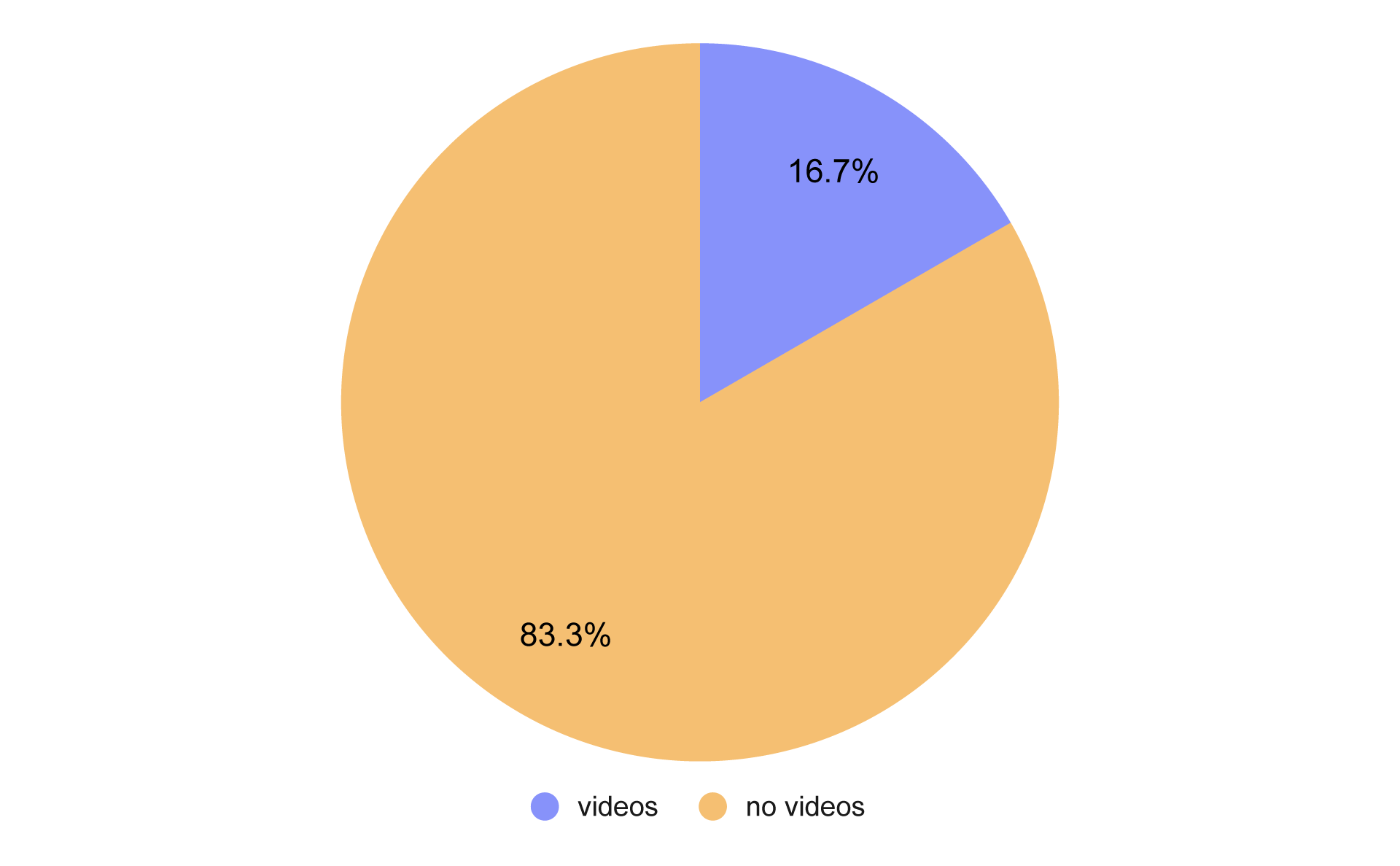
Share of Small Business Blog Posts With Video
Among the group of business websites with blogs that we analyzed, 16.7% included videos in their blog posts.
Should blog posts have a comment section?
For small business blogs, a comment section is usually unnecessary. We are talking about small businesses, which means the number of comments is unlikely to be high. A message such as “No one has commented on this post yet" can actually have a negative impact and make the blog appear less engaging.
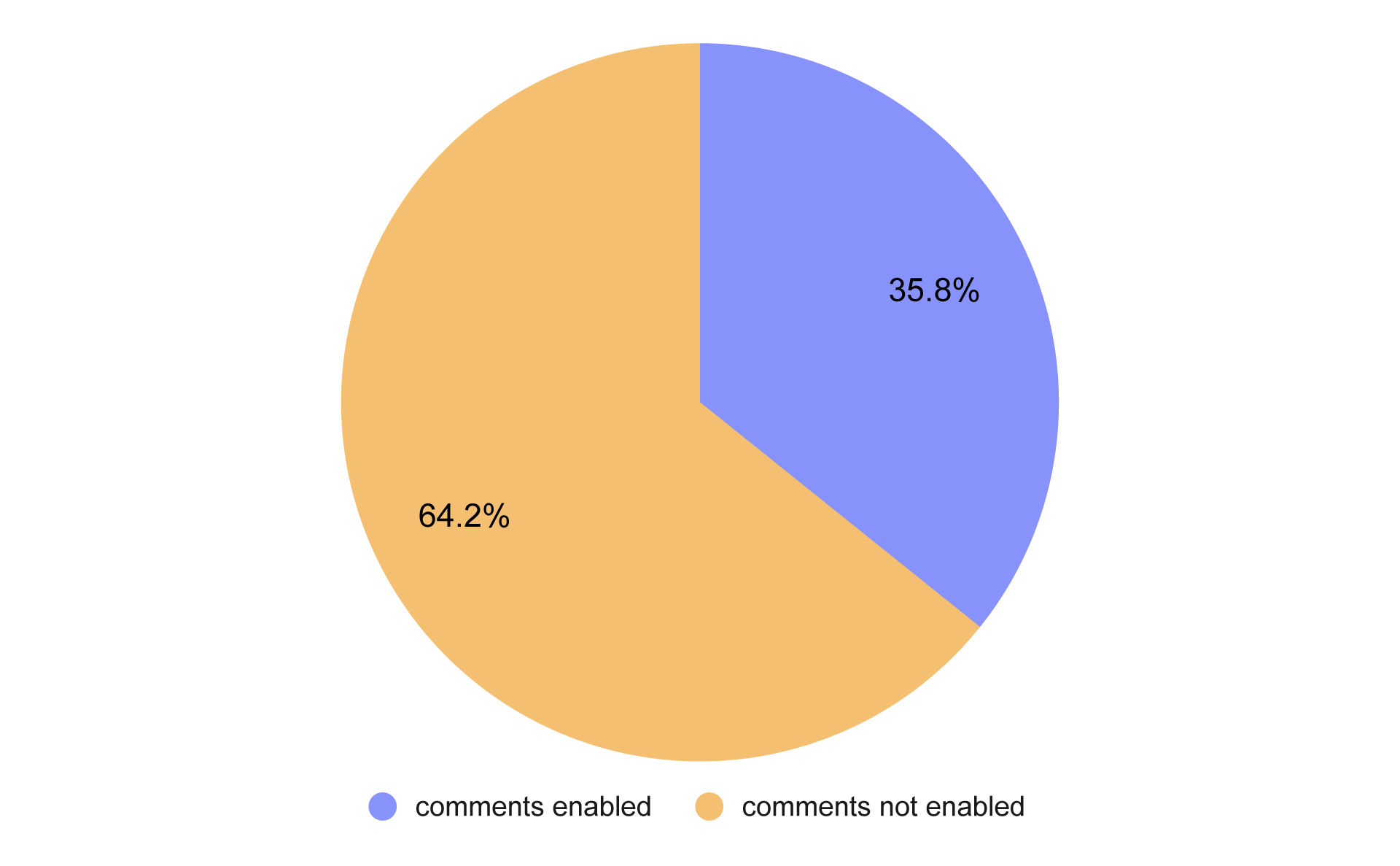
Percentage of Small Business Blog Posts With Comments Enabled
Despite this, quite a significant number of small business websites - 35.8% - had a comment section enabled for their blog posts.
How to optimize blog content for SEO?
Of course, if search engines do not find your blog posts first, readers will not find them either. That is why your content should meet certain technical requirements.
We cover these topics in more detail in our guide Technical SEO Checklist for Small Business Websites to Finally Rank on Google, but below you can find a shortened version focused specifically on blogs:
How long should a blog post be?
There is no single optimal length - a blog post should be as long as necessary to properly answer the user’s query.
However, there are some general guidelines worth keeping in mind. Below 300 words, search engines may have difficulty understanding the topic of the page, and content of this length can hardly be considered a full blog post.
A reasonable minimum length for a blog post is around 500 words.
And at the other end of the spectrum are very long articles - over 2,000 words. Few blog posts exceed this length because such content can be difficult to read in one sitting. However, that is not necessarily a disadvantage. Articles of this length can serve as pillar content - comprehensive, definitive resources that cover a broad topic in depth and act as a hub for multiple smaller, more specific subtopics. They can be especially valuable for targeting long-tail keywords in SEO.
How long were the blog posts we found on the business websites we analyzed?
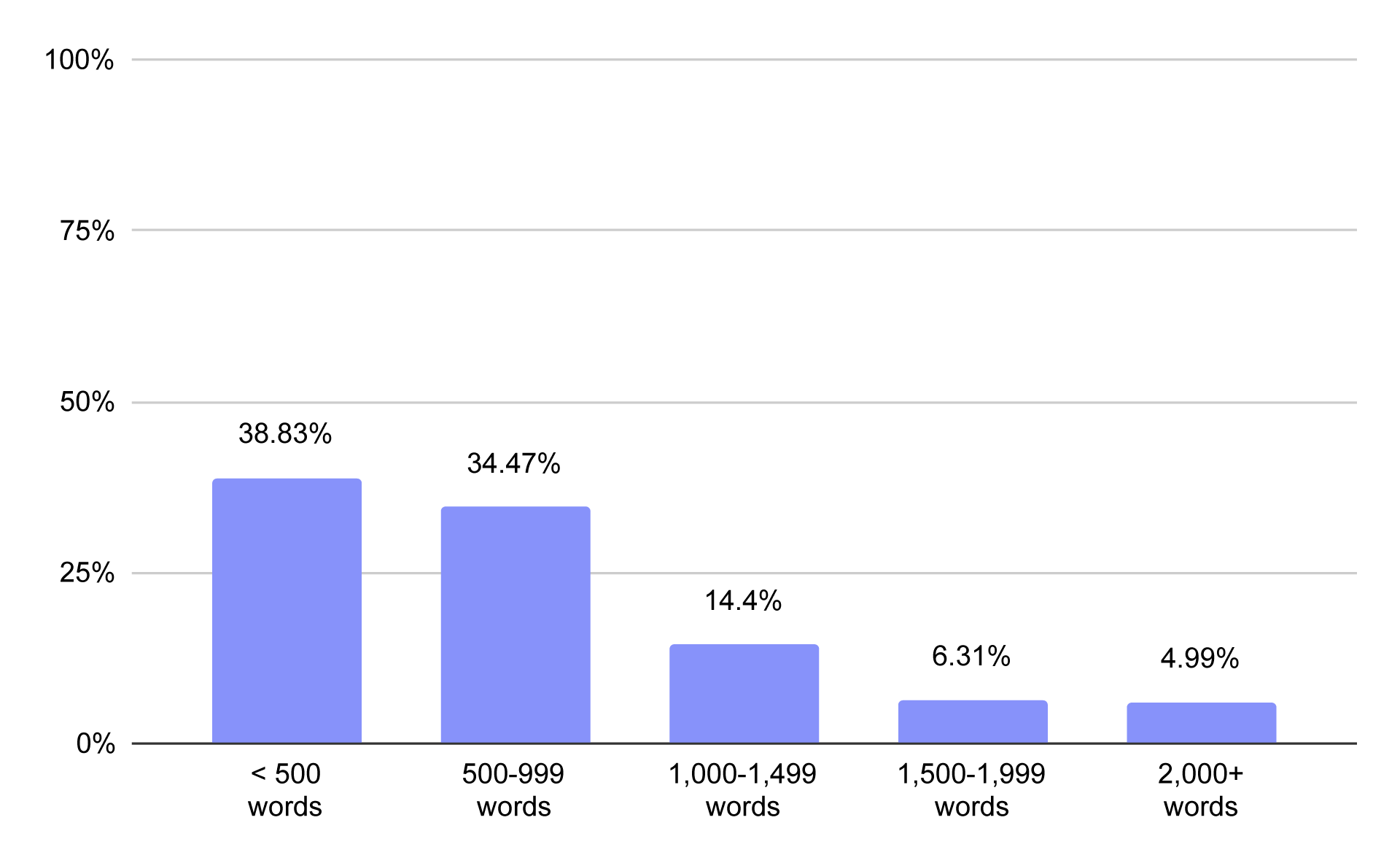
Percentage of Small Business Blog Posts by Word Count
Among the small business websites we analyzed, blog content was heavily focused on shorter articles:
38.83%of blog posts had fewer than 500 words - very short content that may struggle to rank for competitive topics34.47%had between 500 and 999 words - short-form blog posts14.4%had between 1,000 and 1,499 words - medium-length articles6.31%had between 1,500 and 1,999 words - longer, more in-depth content4.99%had 2,000+ words - very long articles that can serve as pillar content
Overall, small businesses tend to focus on short and very short blog posts, with only a small percentage creating longer, comprehensive resources.
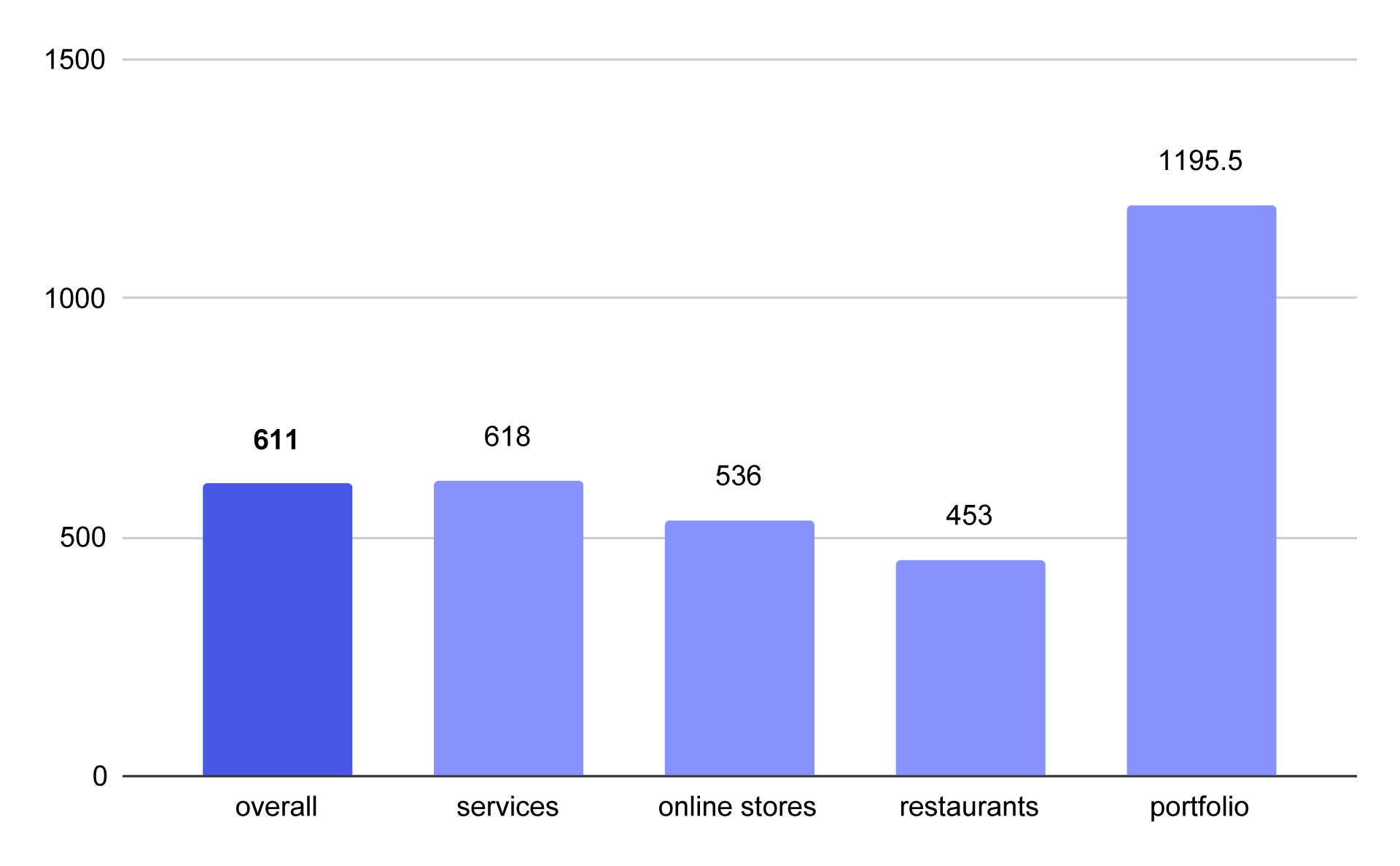
Median Blog Post Word Count by Business Type
The median blog post length among the small and medium-sized businesses we analyzed was:
- Overall:
611 words - Service businesses:
618 words - Online stores:
536 words - Restaurants:
453 words - Portfolio websites:
1,195.5 words
Portfolio and personal websites put the most effort into demonstrating expertise and creating more comprehensive content, with blog posts reaching a medium-length range. Other types of business websites stayed closer to the boundary between short and very short blog posts.
Heading structure and table of contents
Heading structure is a very important element at the intersection of technical and content SEO. A well-organized heading structure helps search engines better understand and interpret the content, and it can also increase the chances of being included in AI-generated citations.
A proper heading structure should create a logical hierarchy:
- One H1 heading placed at the beginning of the content, before any other headings
- H2 headings used as the main content sections, dividing the article into its most important parts
- H3 headings and lower-level headings used to organize information within each section more clearly.
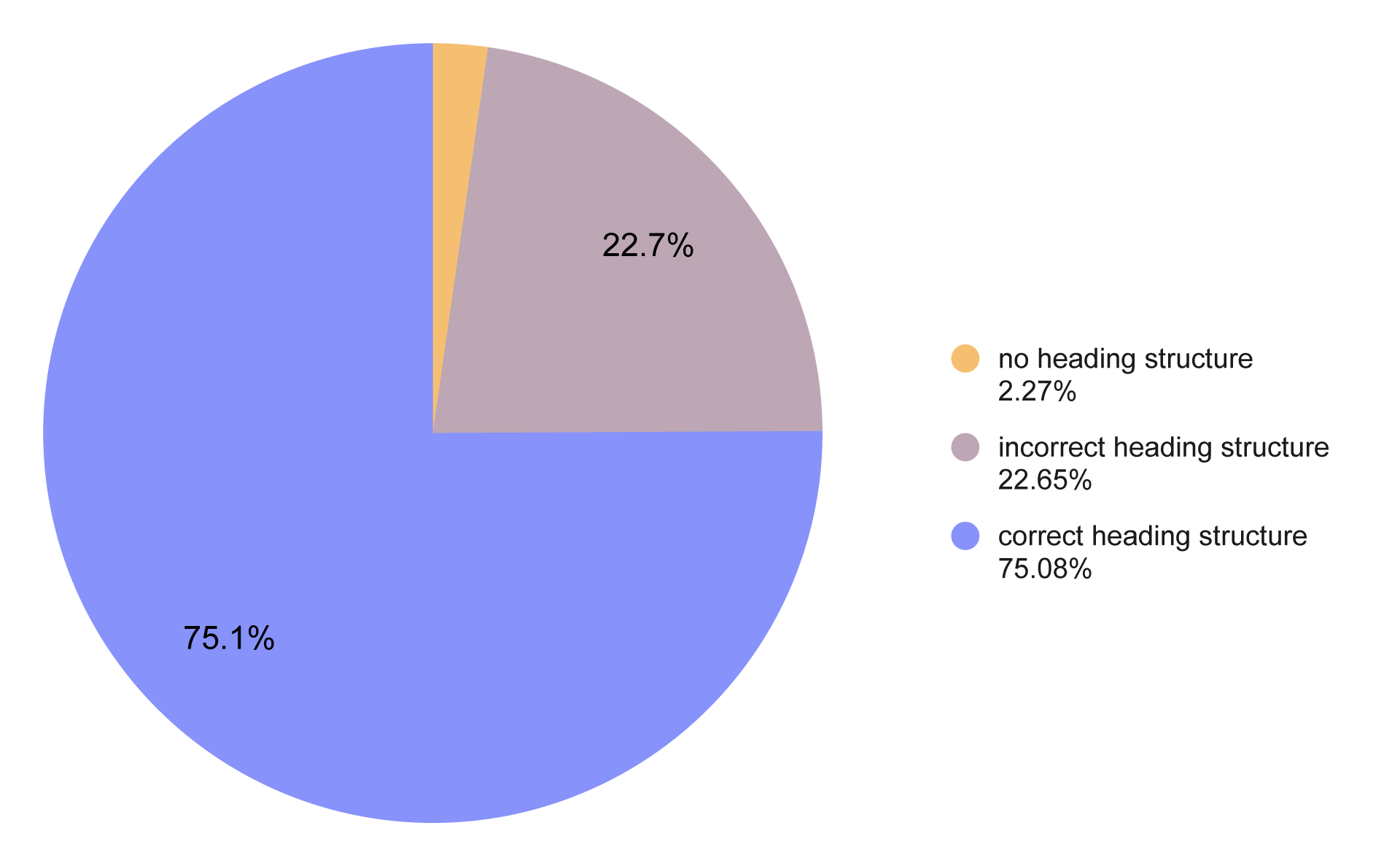
Heading Structure in Small Business Blog Posts
Among the small business websites with blogs that we analyzed, 75.1% had a correct heading structure. On 22.7% of websites, the structure was incorrect (for example, multiple H1 headings or no H1 heading at all), and 2.27% did not have any heading structure, which is also a significant mistake.
Besides heading structure, another useful way to organize content is a table of contents. Should every blog post have one? No - this type of content organization is most useful for longer articles.
For posts under 1,000 words, a table of contents is usually unnecessary. Between 1,000 and 2,000 words, it depends on the complexity of the content. For articles longer than 2,000 words, a table of contents will almost certainly improve readability and navigation.
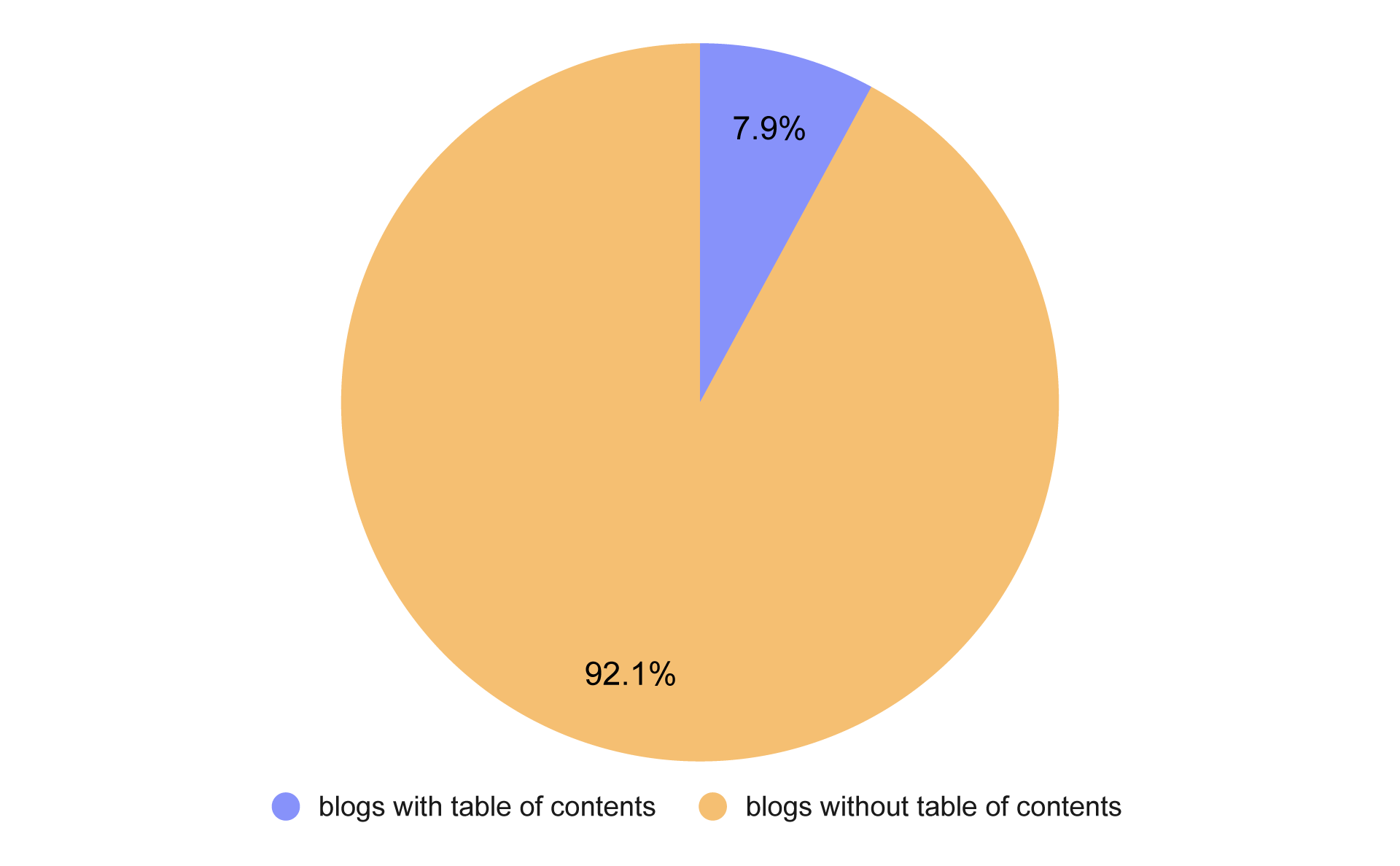
Percentage of Small Business Blog Posts With a Table of Contents
Among the small business websites with blogs that we analyzed, 7.9% included a table of contents, while 92.1% did not. This is not surprising - as we already know, our sample was dominated by short and very short blog posts, where adding a table of contents was usually unnecessary.
Internal links
Internal links are links leading to other content on the same domain. They are important for three main reasons:
- They help search engines understand the structure of your website
- They help users discover related content and increase the time they spend on your website
- They guide users toward conversion points
How many internal links should a blog post have? Not too many - you don’t want your article to look spammy - but not too few either, because you want to take advantage of the SEO and user experience benefits internal linking provides.
A reasonable number is 2–5 internal links per 1,000 words.
We checked whether small businesses are taking advantage of the potential that internal links provide in blog posts.
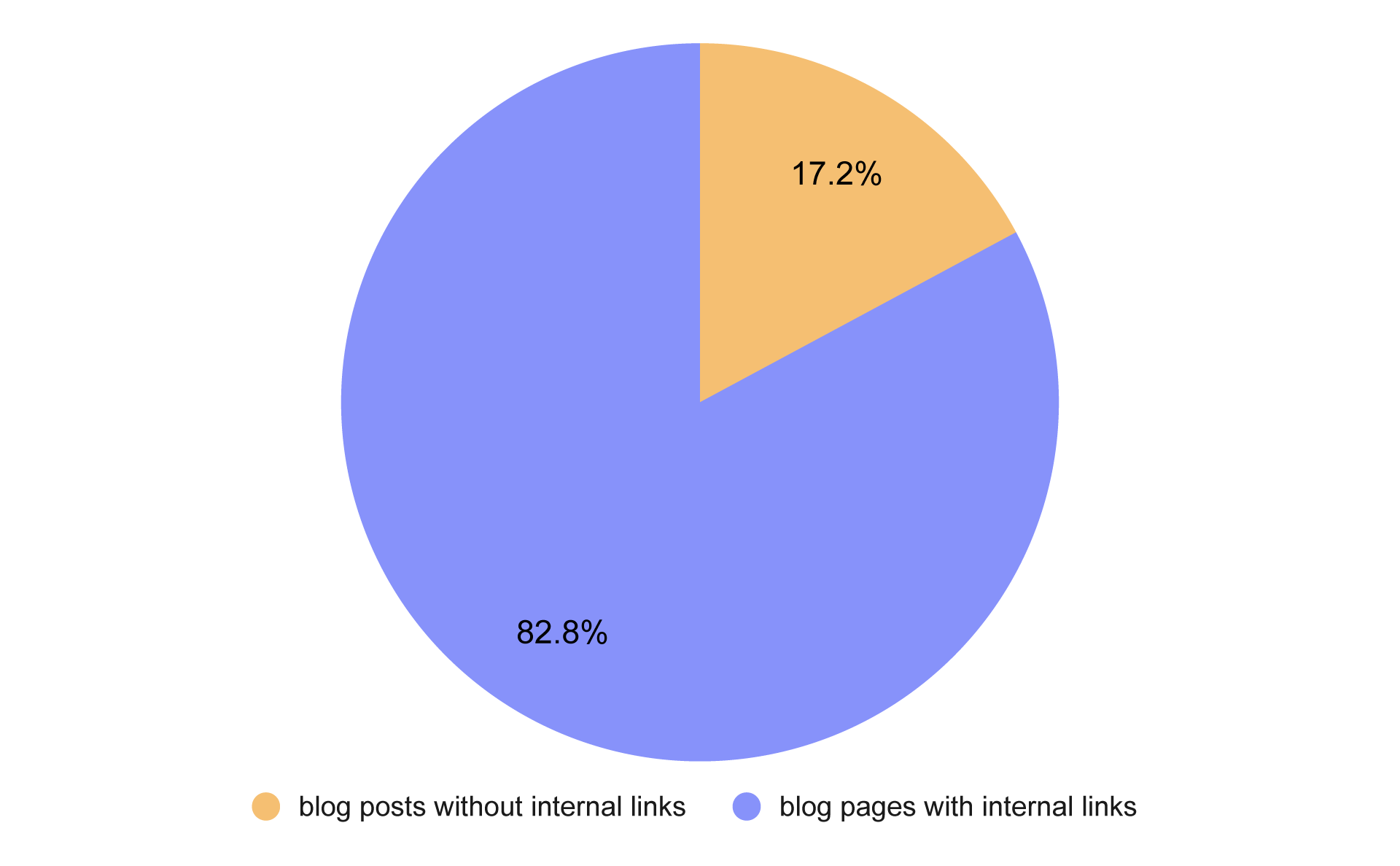
Percentage of small business blog posts with internal links
It turns out that 17.2% of small businesses did not include a single internal link in their blog posts.
Turn blogging into your competitive advantage
Blogging has real potential for small businesses - especially because so few of them are doing it well.
Only a small share of small businesses actively maintain a blog, and even among those that do, many make basic strategic mistakes: they publish without a plan, give up after a few posts, or fail to optimize their content for search and conversion.
That leaves plenty of room for businesses willing to treat blogging as a long-term part of their marketing strategy and do it right.
Of course, running a business already takes up most of your time. That's why the tools you choose matter. With IKOL, you can manage your business and website in one place, use AI-assisted writing to turn your knowledge into blog posts, generate visual content, and publish everything in a carefully designed blog built into your business website.