How To Display Business Hours On Your Website?

Imagine this: it’s late, you’re starving after a long day, and you find a great restaurant online. But… nowhere on the website can you find their open hours. You take a chance, drive there, and—bam—it’s closed. Frustrating, right?
The same goes for your business. If customers can’t quickly find your hours, you’re losing them before they even walk through the door. Yet, many businesses either bury their hours in hard-to-find places or—worse—don’t list them at all.
In this guide on how to display business hours, we’ll break down which businesses should prominently feature their hours, where to place them for maximum visibility, and best practices to ensure customers always know when you’re open.
Should your website display business hours?
In short—it depends on the nature of your business.
At IKOL, we provide web solutions for businesses of all kinds. To better understand the needs of various industries, we analyze websites based on their content. Different industries and sectors tend to include different elements on their websites. Based on our research, we have categorized websites into four main groups:
- Service businesses
- Shops
- Restaurants
- Personal websites and portfolios
All of these websites aim to promote or sell a company, brand, or personal identity, but their nature varies significantly.
So, does a particular type of website need to display business hours? If you're wondering how to display business hours effectively, let’s take a closer look at our findings.
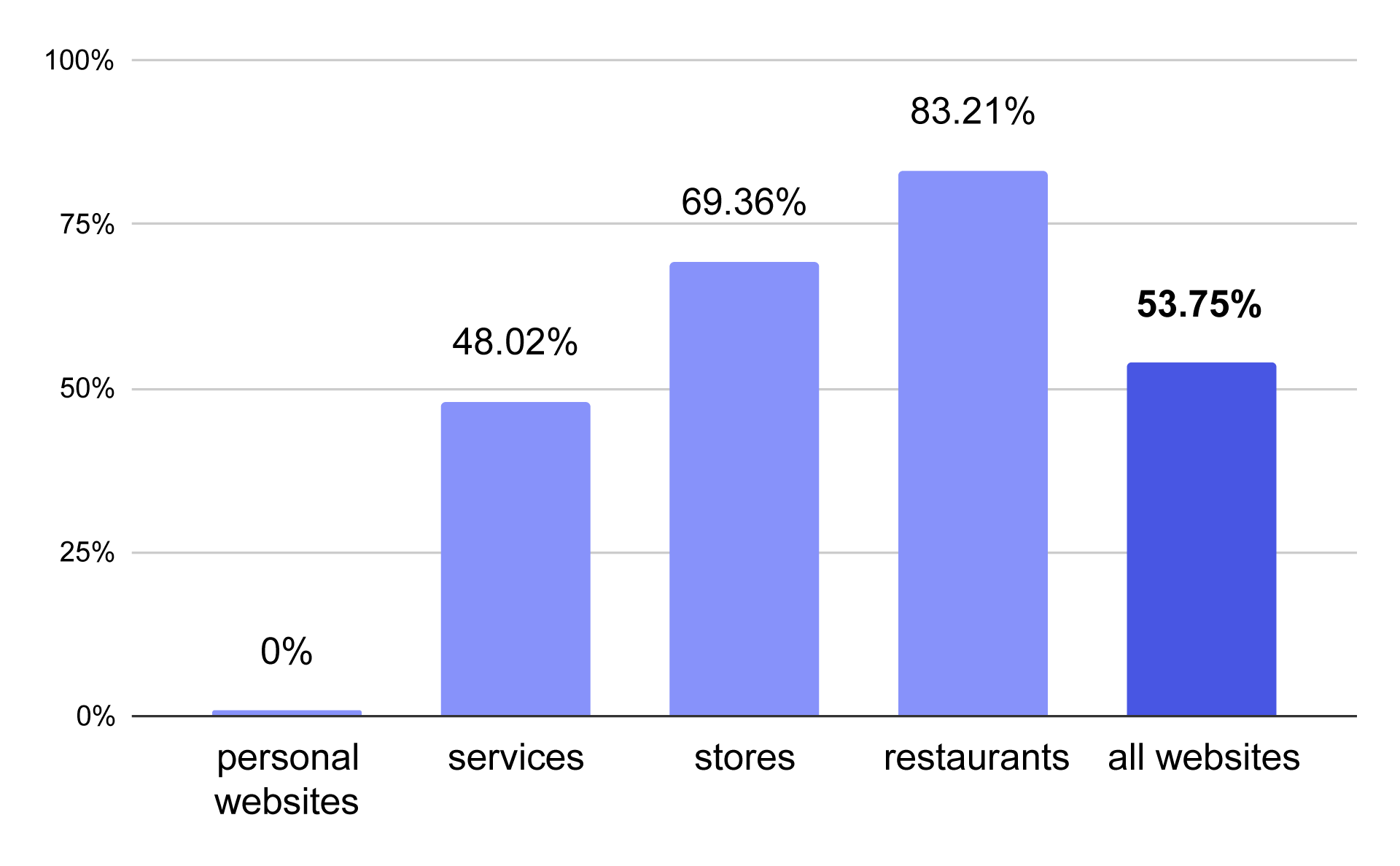
Percentage of websites displaying business hours by type of website
Our analysis found that business hours were displayed on 53.75% of the websites we examined. That’s a rather neutral result. As we mentioned earlier, a lot depends on the type of business website.
Personal websites & portfolios
For personal websites, none displayed business hours. There isn’t much to analyze here—these sites serve as a digital business card rather than a company page. Their primary function is to present the owner’s profile and achievements in a professional and inviting way. The dominant contact methods are email or a contact form, making business hours unnecessary. A very distinct type of business website.
The more interesting insights come from the other types of business websites.
Service business websites
According to our research, 48.02% of service business websites displayed business hours. Our initial thought? That’s quite low. So, we investigated which industries most commonly included business hours on their websites and which did so the least.
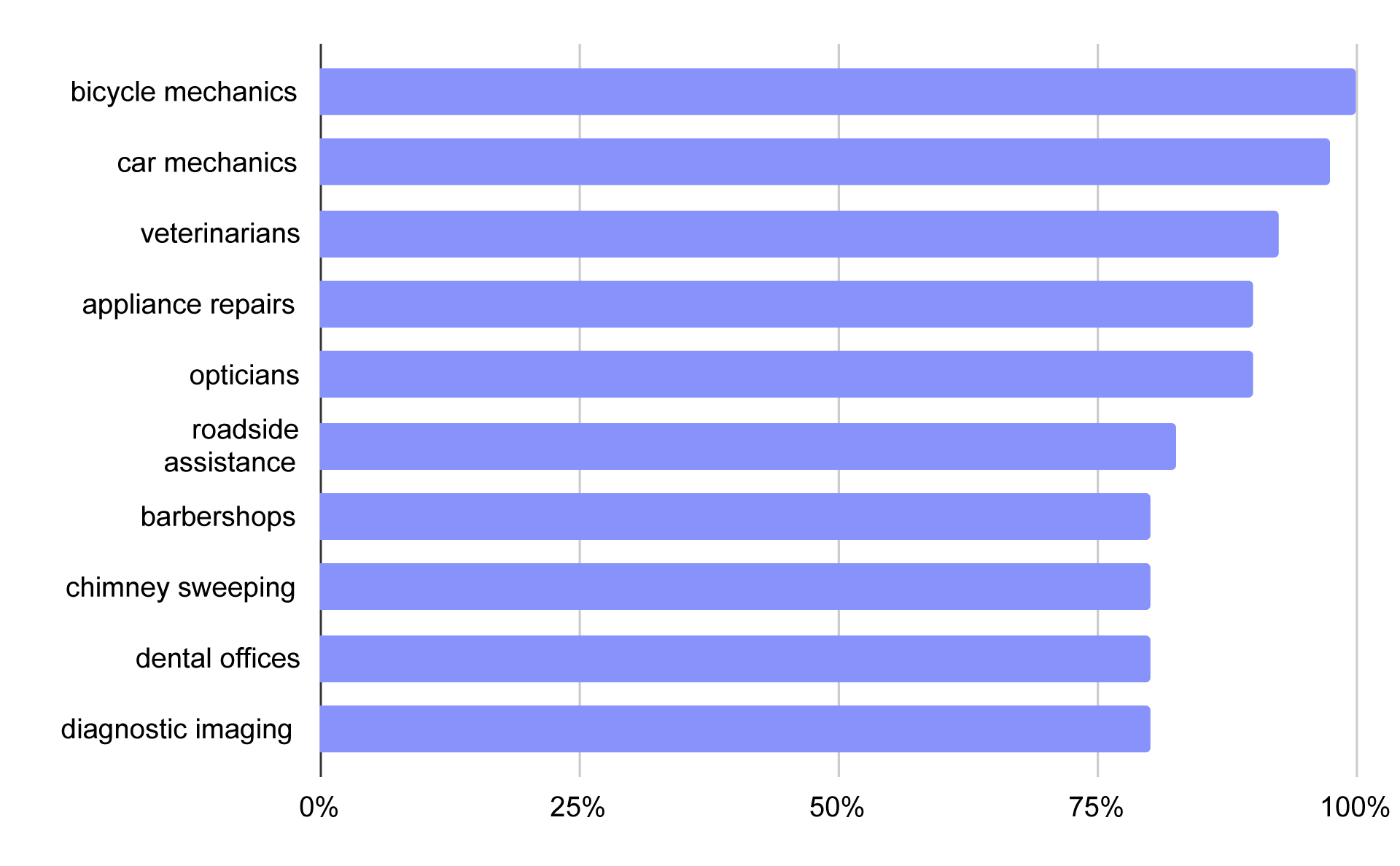
Service industries most frequently displaying business hours on their websites
Industries that most often included business hours generally fell into the category of businesses with physical locations—offices or workshops where they receive customers.
There are, however, a few exceptions to this rule, such as appliance repairs, roadside assistance, and chimney sweeping. In these cases, listing business hours serves to inform customers about when the company is available to travel and complete a job.
The highest percentage of business hours was found on websites of auto mechanics (98%) and bicycle repair shops (100%).
On the other end of the spectrum, the industries least likely to display business hours followed a few key patterns:
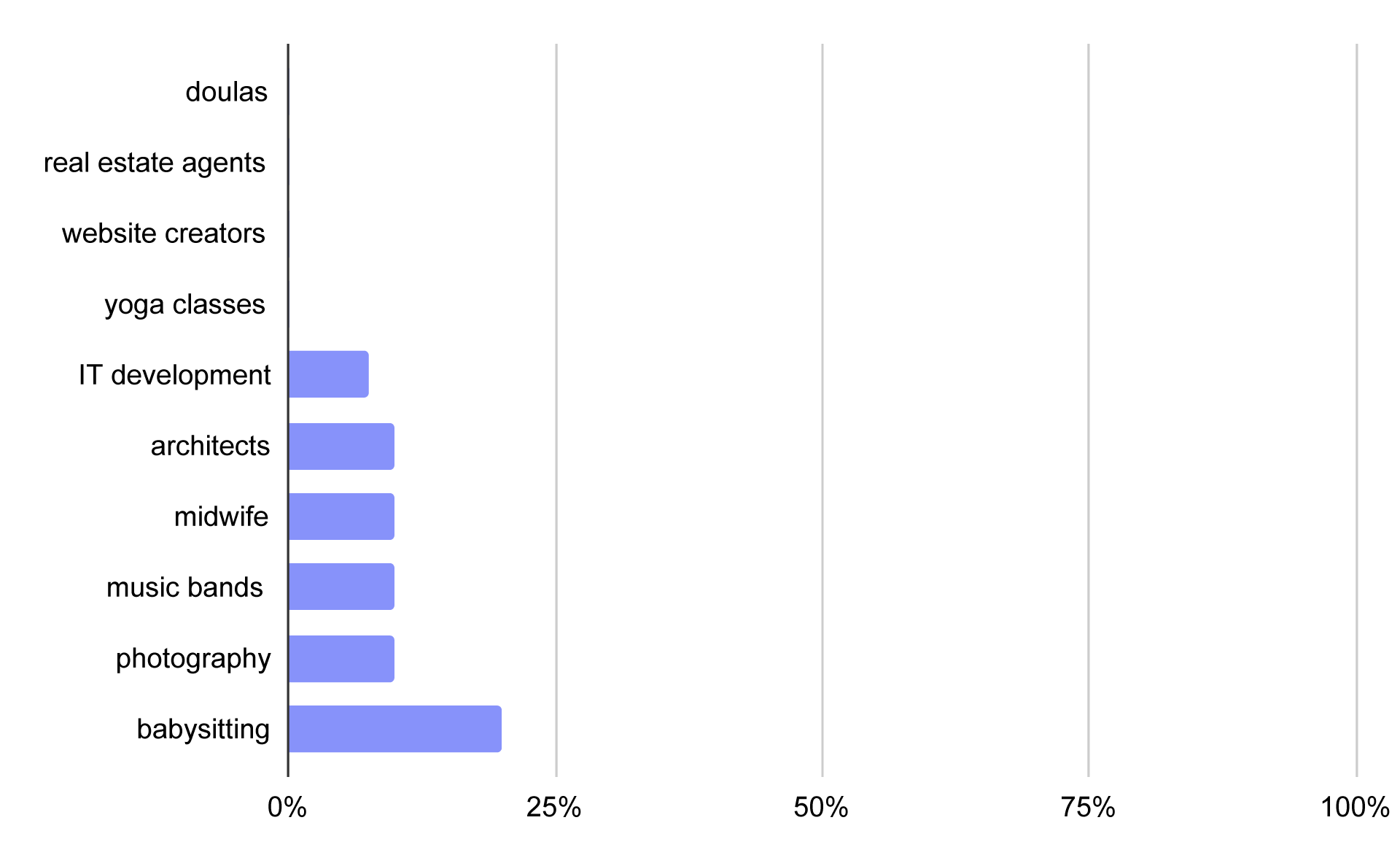
Service industries least likely to display business hours on their websites
The first characteristic of industries that rarely display business hours is the need for flexibility and adapting to customer needs. A striking example is doulas (0% of websites displaying business hours) and midwives (10%)—after all, childbirth doesn’t follow a schedule.
Similarly, real estate agents operate in a highly competitive field, where being available at a client’s convenience can determine whether a lucrative deal is closed - 0% of real estate websites included business hours on their websites.
Another group consists of businesses where client interaction is sporadic, and most of the work happens independently. Examples include website creators (0%), IT development companies (8%), and architects (10%).
Some industries rarely displaying business hours are portfolio-based, such as music bands or photography services.
Meanwhile, for yoga studios, listing business hours is unnecessary—what matters most is the class schedule. That’s why 0% of yoga studio websites included business hours.
Store websites
For business service websites, the presence of business hours depended heavily on the industry. But for shop websites, we observed a different trend:
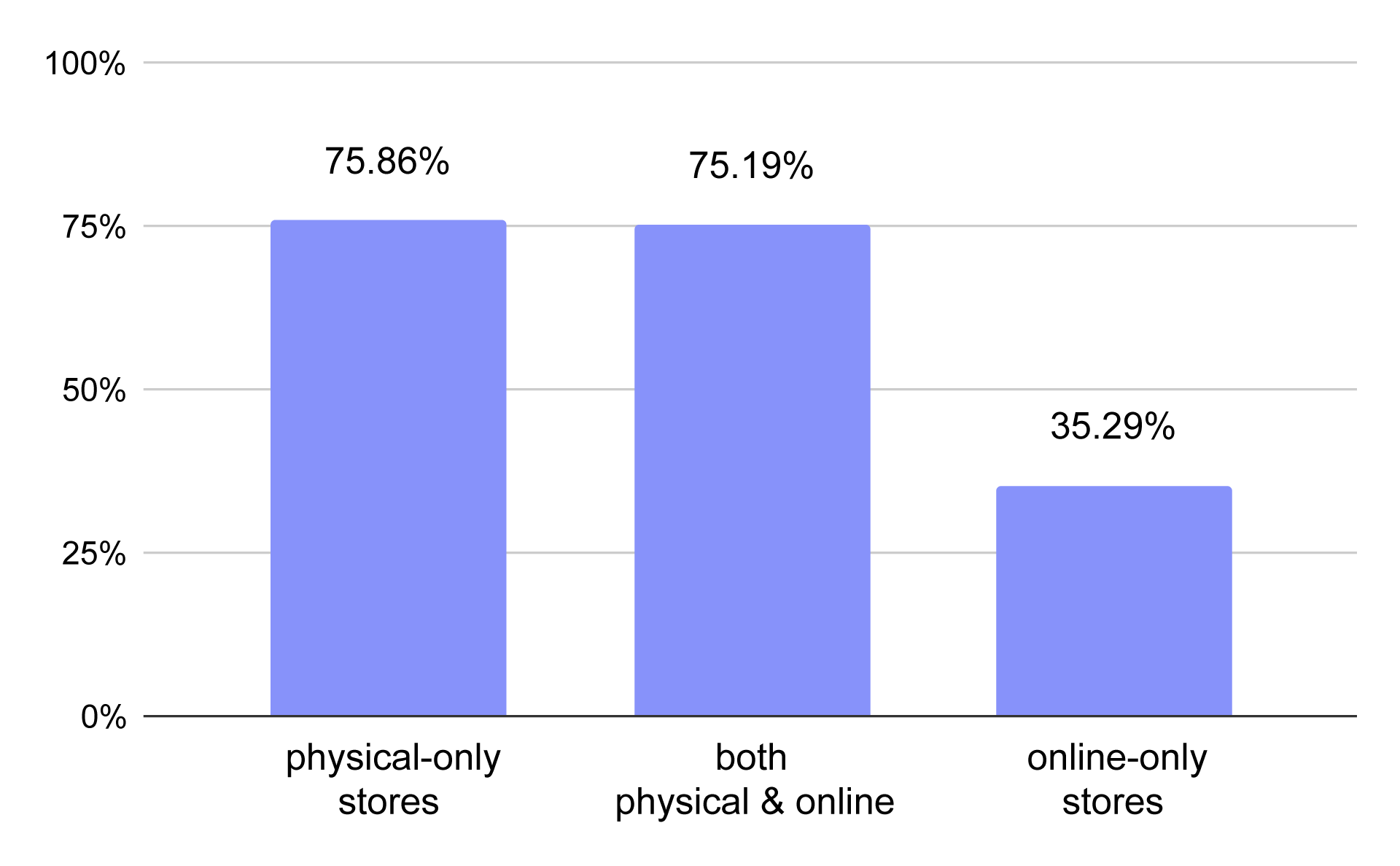
Presence of business hours on shop websites depending on whether they operate in-store, online, or both
Our analysis showed that 69.36% of shop websites included business hours.
A quick disclaimer—not every store website is an online store. Some businesses operate solely from a physical location and use their website as a digital business card. Others have a hybrid model, selling both online and in-store. And of course, some stores are exclusively online.
The presence of business hours on store websites is closely linked to whether they have physical locations. Our analysis found that 75.86% of brick-and-mortar stores displayed business hours, while 75.19% of hybrid stores (both physical and online) included them as well. In contrast, only 35.29% of online-only stores featured business hours, and when they did, they typically referred to customer service availability. A notable exception was fashion designer websites—just 10% displayed "open by appointment" hours, mainly for showroom visits upon request.
If you’re unsure how to display business hours effectively for an online or hybrid store, consider whether your customers need to visit a physical location or simply require access to customer support hours.
Restaurant websites
Restaurants were the most likely to display their business hours—83.21% of restaurant websites included this information. No surprise here—restaurants almost always operate from a physical location.
One standout exception? Food trucks. Among food truck websites, business hours were displayed on only 48% of pages.
Why? Because food trucks are a unique type of food business—they are often mobile, move to event locations, and leave when foot traffic slows down. Their operations are also weather-dependent. In colder climates, many food trucks only open seasonally or during good weather conditions.
How to display business hours on a website?
Now that we’ve established whether it’s worth displaying business hours, the next question is—how to display business hours effectively?
The answer largely depends on the working model of your business. Different industries operate on different schedules, and effectively communicating your availability ensures a smooth customer experience. Let’s explore the best ways to present business hours based on various work models.
Fixed business hours
The most common approach is to display fixed opening hours. In some cases, a simple and classic "Mon–Fri: 9:00 AM–5:00 PM" is sufficient. However, when hours vary by day, it’s best to list each day separately to avoid confusion. In certain cases, highlighting special exceptions—such as extended hours on specific days or days when the business is closed—can also be helpful.
Fixed business hours generally follow several established patterns:
- The standard 9-to-5 model – This is typical for offices and businesses that operate during regular business hours, catering primarily to corporate clients and professionals.
- The retail model (e.g., 10 AM–8 PM) – Found in shopping malls, boutiques, bookstores, and certain service businesses like beauty salons.
- The hospitality model (e.g., 12 PM–10 PM) – Common for restaurants and cafes, which open before lunch and stay open late into the evening.
- The evening & nightlife model (e.g., 6 PM–2 AM) – This applies to bars, nightclubs, and certain food trucks, which cater to customers in the late hours.
By clearly stating business hours, companies help customers know when they can visit, reducing frustration and unnecessary inquiries.
Seasonal business hours
Some businesses operate only during specific seasons but still maintain fixed hours within their active periods. These businesses need to communicate both their daily schedule and the timeframe in which they are open—whether it’s summer, winter, or a specific festival period.
Common examples include:
- Ice cream parlors and seasonal food trucks – Typically open during warm months.
- Tourist equipment rentals – Available only when demand is high, such as winter for ski rentals or summer for bike rentals.
- Attractions and recreational businesses – Such as amusement parks, water parks, or outdoor adventure activities that close in the off-season.
For seasonal businesses, it’s good practice to update the website before each operating period to avoid customer confusion.
24/7 business model
Certain industries require round-the-clock availability, which means they operate 24/7. Businesses in this category typically do not need to specify business hours in a traditional way, but they should clearly communicate their always-open status.
Industries that follow this model include:
- Hotels and accommodations – Reception desks are often open 24/7.
- Security companies – Must be available at all times to respond to emergencies.
- Taxis and ride-hailing services – Operate continuously to meet customer demand at any hour.
- 24-hour convenience stores and pharmacies – Serving customers regardless of the time of day.
- Fast food chains – Some locations offer late-night or all-night service.
When displaying 24/7 availability, it’s useful to emphasize key services (e.g., "Emergency Support Available 24/7") and ensure contact methods (phone, chat, or booking system) are clear.
No business hours? Or just flexible hours?
Some businesses don’t display business hours at all—but that doesn’t mean they don’t have them. Instead, their hours are highly flexible, adapting to client needs rather than following a set schedule.
This is common in industries such as:
- Freelancers – Graphic designers, developers, and consultants often work on a project basis, adjusting their hours accordingly.
- Personal trainers & coaches – Appointments depend on client availability.
- Event planning companies – Hours vary depending on event schedules, so setting fixed hours doesn’t make sense.
For businesses with flexible hours, the best approach is to emphasize how to book a service rather than displaying specific times.
💡Tip: You don’t need to sit by the phone or constantly check emails if your website includes a booking system
Allowing customers to schedule appointments directly on your site makes communication more efficient and eliminates uncertainty.
Where to display business hours on a website?
Depending on the industry and operating hours model, business hours can be placed in various locations on a website. Knowing how to display business hours effectively ensures customers can find this critical information quickly and effortlessly. Let’s go over the best (and worst) places to display business hours.
Homepage
If your business relies on foot traffic or has high in-person customer interaction, placing business hours on the homepage removes friction for users. For example, a restaurant should make it clear when it’s open, while an auto repair shop benefits from prominently displaying service hours.
- Customers see business hours immediately—no need to click through pages.
- Ideal for retail businesses and local service providers, where quick access to hours improves the user experience.
This is one of the most effective ways to approach how to display business hours, especially for retail businesses and local service providers, where quick access to hours improves the user experience.
✅ Best for: Brick-and-mortar businesses, restaurants, physical stores, gyms, pharmacies, repair services.
⚠️ Not ideal for: Large corporations, online service providers, e-commerce businesses.
Contact page
If users are searching for an address or phone number, they often need business hours as well. Placing them on the contact page makes sense, especially for businesses with flexible schedules where customers may want to confirm availability.
- A logical location—users looking for contact details often check this page for business hours.
- Works well for businesses with varying hours, where customers may need to confirm availability.
This is a practical way to display business hours for service-oriented businesses, ensuring customers can easily find the information when reaching out.
✅ Best for: Service providers, consultants, workshops, freelancers.
⚠️ Not ideal for: Restaurants, stores, or high-traffic physical locations.
Website header
For businesses that operate nonstop, adding business hours to the header provides instant reassurance to visitors. If your business is always open, it’s a strong selling point that should be highlighted upfront.
- Instantly visible—users don’t have to search for it.
- Perfect for 24/7 businesses that need to emphasize their round-the-clock availability (e.g., "Open 24/7!").
This is an effective way to highlight availability, especially for businesses that depend on accessibility at any hour.
✅ Best for: 24-hour businesses, fast-food chains, pharmacies, casinos, hotels.
⚠️ Not ideal for: Most service-based businesses, corporations, online stores.
Website footer
If business hours are important but not the main focus, placing them in the footer ensures they are accessible without distracting from key content. This is a universal placement that works well for most businesses.
- A standard location—users intuitively check the footer for business information.
- Doesn’t take up space on the main page but is always accessible across the website.
- Works best in combination with the Contact Page for easy navigation.
This is a non-intrusive yet effective way to display business hours across a website without overwhelming visitors.
✅ Best for: Almost any industry.
⚠️ Not ideal for: Businesses where operating hours are critical to customer decisions (e.g., restaurants, pharmacies).
What NOT to do
Some placements hurt usability and SEO, making business hours harder to find or update. If you’re wondering how to display business hours effectively, avoid these mistakes:
❌ Business hours in images – Search engines won’t index them, meaning they won’t appear in search results. Also, updating an image is inconvenient.
❌ Hours hidden in FAQ – Users looking for business hours shouldn’t have to dig through a FAQ section to find them.
❌ Hours buried deep in subpages – If it takes more than a couple of clicks to find your business hours, they might as well be invisible.
❌ A separate page just for business hours – Unless business hours change frequently or require detailed explanations, dedicating an entire page to them is overkill. Instead, integrate them into relevant sections like the homepage, contact page, or footer.
Business hours: make them work for your website
Business hours are a crucial piece of information for any company. Knowing how to display business hours clearly can boost customer trust, improve accessibility, and drive more business.
To communicate them effectively, you need to:
-
Understand your industry’s needs—whether your business follows fixed, seasonal, 24/7, or flexible hours.
-
Choose the right placement—homepage, contact page, header, or footer, depending on how critical they are to your visitors.
-
Avoid common mistakes—like hiding hours in images, FAQ sections, or buried subpages.
But here’s the good news—you don’t have to figure out how to display business hours yourself. We’ve already done the work for you. 😉
With our website generator, you get a professionally designed site, optimized for your industry, with business hours displayed exactly where they need to be. No hassle, no guesswork—just a solid, well-crafted website tailored to your business needs.